Combine the PV Strings
Each string enters through its own cable route and protection point. The outputs join on a busbar or other approved combining arrangement before leaving the box through one or more output circuits.
UFELE Electric — Solar Pumping, Industrial Drives and PV Protection
Email: sale@ufele.com | B2B Supply and OEM Orders

UFELE supplies DC, AC and hybrid PV combiner boxes for solar installations. A DC solar combiner box collects several PV strings before the inverter. An AC combiner groups suitable inverter outputs. A hybrid enclosure keeps planned DC and AC circuits in separate sections of one project-specific layout.
Selection starts with the solar panels, string count, maximum system voltage and current. Overcurrent protection devices, surge protection devices, circuit breakers or disconnects, enclosure material, cable entry and optional monitoring devices then shape the final configuration. Send a string table or single-line diagram for a useful review.
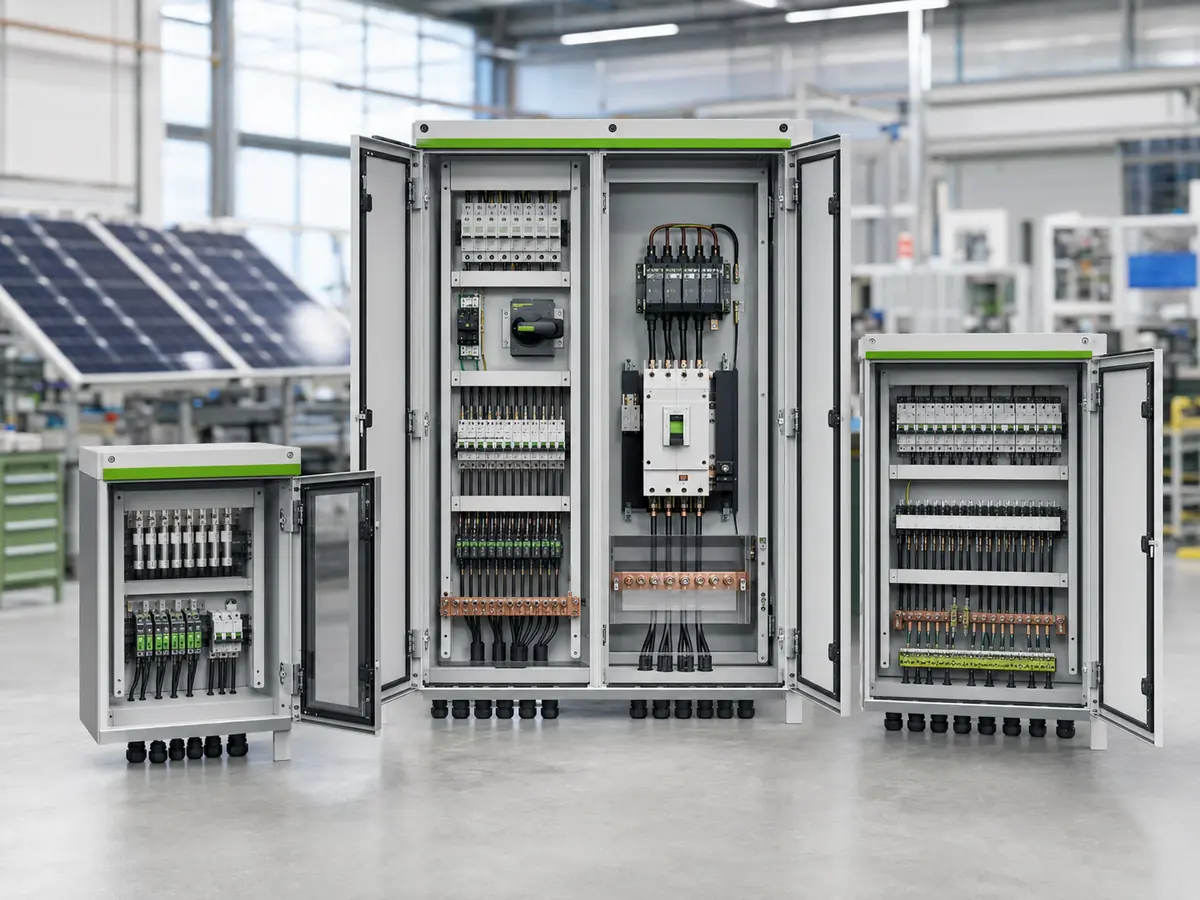
The layout is checked by circuit type, string count, protection parts, enclosure, and how the box will be installed on site.
A solar PV combiner box is an electrical enclosure that brings several DC circuits from the solar panels into one or more organized output circuits. The combined output then runs toward the inverter or another defined point in the PV system. This arrangement reduces separate field cable runs and creates one accessible location for circuit protection, isolation and service checks.
Not every PV system needs a separate combiner. The inverter input design, number of PV strings, local electrical rules and project layout decide whether one is required. A qualified system designer should confirm the circuit ratings and protective-device coordination before installation.
Each string enters through its own cable route and protection point. The outputs join on a busbar or other approved combining arrangement before leaving the box through one or more output circuits.
PV-rated fuses or circuit breakers can provide overcurrent protection when the design requires it. Surge protection devices address transient overvoltage. A switch disconnector can provide an isolation point. These parts perform different jobs and must match the DC or AC circuit.
Review related solar DC protection products.
Optional monitoring devices can measure string current, system voltage, temperature or device status. State the required values, communication method and auxiliary power before quotation because monitoring is not standard in every box.
A DC box normally sits between the PV array and inverter. An AC box sits after suitable inverter outputs and before the next distribution point. The exact location follows the single-line diagram. Installers need clear wiring space and cable entry. Project buyers also need confirmed voltage, current, protective devices and enclosure requirements.
Rooftop systems often need compact routing and practical service access. Ground-mounted systems may place more weight on the enclosure, environmental exposure and repeatable layouts. Distributor stock orders need common string counts, stable labels and consistent packing. Select the box from the circuit data, not only the model name.

When several PV strings reach the same area, the box helps keep wiring easier to follow. This matters later when installers check a string, replace a fuse, or trace a cable problem.

The layout may include string fuses, PV-rated circuit breakers, a disconnect, surge protection devices, terminals and a busbar. Confirm each device rating and its position before the box is quoted.

Outdoor boxes need more attention to enclosure, sealing, cable glands, sunlight exposure, rain, dust, and service access. IP rating should match the site expectation.
UFELE organizes combiner boxes by circuit side and wiring purpose. Use these three groups as a first filter, then send the string or output details for layout review.

A DC combiner works on the PV string side. Buyers normally specify string count, maximum DC voltage, string current, output arrangement, fuse or breaker choice, disconnect, SPD, enclosure, cable entry and optional monitoring.

A hybrid box places planned DC and AC functions in one enclosure while keeping the circuits properly separated. Send a single-line diagram, device list and cable schedule because a hybrid box is not a generic string combiner.

An AC combiner groups suitable inverter AC outputs before the next distribution point. Buyers normally confirm phase, voltage, current, output count, circuit breakers, meter or monitoring request, transfer option and cable arrangement.
These model names are used as a starting point for discussion. Final supply still depends on component choice, enclosure, cable entry, protection layout, and current file version.
| Group | Model Examples | Where Buyers Usually Consider It |
|---|---|---|
| DC Small String Boxes | FUCB-MDP1/1N, FUCB-MDP2/1N, FUCB-MDP3/1N, FUCB-MDP4/1N, FUCB-MDP5/1N | Smaller PV string layouts where buyers want a compact DC protection box. |
| DC Multi-String Boxes | FUCB-MD6/1, FUCB-MD8/1, FUCB-MD10/1, FUCB-MD12/1, FUCB-MD14/1, FUCB-MD16/1, FUCB-MD20/1, FUCB-MD24/1 | Projects with more PV strings and a need for organized string input and protection layout. |
| DC Multi-In Multi-Out | FUCB-MD multi-in multi-out | Layouts where the buyer does not want a simple many-in-one-output arrangement. |
| DC/AC Hybrid | FUBH DC-2AC-1, FUCB-DA1-1 | Projects where DC and AC circuit arrangement should be planned together. |
| AC Combiner Box | FUCB-LA3/1, FUCB-LA4/1, FUCB-LA8/1 | AC output grouping, three-phase meter option, or dual power transfer switch discussion. |
A useful price comparison needs the same electrical and mechanical scope. A low quote may cover only an enclosure and basic terminals, while another quote includes PV-rated overcurrent protection devices, surge protection, a disconnect, monitoring, labels and project documents. Send the configuration below so suppliers quote the same requirement.
More PV strings, multiple outputs and larger conductors increase the number of devices, busbar capacity, wiring work and enclosure space.
Maximum voltage, string current, output current and fault conditions affect the fuses, circuit breakers, disconnects, terminals and conductor sizes.
Material, IP requirement, size, cable glands, component brands, surge protection devices and environmental limits all change the bill of materials.
Sensors, communication, auxiliary power, meters, custom labels, inspection files, manuals, packing and order quantity affect the final quotation.
Start with the solar panel datasheet and the way modules are connected into PV strings. Record the number of strings, maximum calculated system voltage, string current and required output arrangement. These values guide the electrical ratings, but the system designer must also coordinate the protective devices with the modules, conductors, inverter and local rules.
Next, check the installation. Bottom or side cable entry, conductor size, gland type, terminal space and service clearance affect the internal layout. Ambient temperature, sunlight, rain, dust, corrosion and mounting location affect the enclosure and component derating. Do not select a box only from its string count.

| Project Data | Why It Matters | What to Send |
|---|---|---|
| PV array and string layout | Sets the number of input circuits and how they combine. | String table or single-line diagram |
| Voltage and current | Guides the ratings of devices, busbars, terminals and conductors. | Module datasheet, calculated maximum voltage, string Isc and output current |
| Protection and isolation | Defines fuses or breakers, surge protection and disconnecting means. | Required device type, poles, rating, standard and preferred brand |
| Installation environment | Affects enclosure material, sealing, glands, temperature limits and mounting. | Indoor or outdoor location, exposure, ambient range and IP request |
| Monitoring | Changes sensors, communication, auxiliary power, wiring and enclosure space. | Measured values, protocol, interface and destination system |
| Market and documents | Affects component approval, labels, inspection scope and file package. | Destination market, project standard, label language and required documents |
Combiner box design changes with the installation. A rooftop system, ground-mounted array and solar pumping project may all use a PV combiner box, but string count, cable route, environmental exposure and protection requirements differ.

Rooftop projects usually care about compact layout, neat cable routing, enclosure protection, and easy service access.

Larger projects may need more string inputs, clearer labeling, stronger enclosure planning, and repeatable box layouts.

Solar pumping projects may use a combiner box between PV strings and the solar pump inverter, especially when multiple strings are used.

Distributor orders often focus on common string counts, stable packing, carton marks, product photos, and repeat supply.
String count, maximum DC voltage, string current and output arrangement define the electrical layout. Enclosure rating and cable-entry direction then shape the box construction.
Combiner Box Selection Guide
A reliable comparison needs more than a box photo. Confirm the device list, wiring layout, component brands, labels, carton marks, inspection scope, datasheets and packing details. For distributor or OEM orders, approve one controlled specification before repeat supply starts.
UFELE can review fuse holders, PV fuses, circuit breakers, disconnects, surge protection devices, terminals, busbars, cable glands, meters and monitoring devices against the project layout.
Ask for current datasheets, layout references, product photos, packing photos, and available document files before final approval.
Labels, carton marks, item codes, manuals, barcode requests, and repeat order files can be discussed for distributor and private label orders.
These questions are common before buyers send a combiner box inquiry or replacement request.
A DC PV combiner box brings the outputs of multiple PV strings into one organized output circuit before the inverter. Depending on the design, it can also house string fuses or circuit breakers, surge protection devices, a DC disconnect and optional monitoring devices.
Send the number of PV strings, maximum system DC voltage, string current, output arrangement, protection preferences, enclosure and IP requirements, cable entry direction, monitoring request, quantity and destination market.
DC combiner boxes work on the PV string side before the inverter. AC combiner boxes group suitable inverter AC outputs. A DC/AC hybrid box places both circuit groups in one project-specific enclosure and needs a clear wiring drawing.
Customization can cover input and output count, fuses, circuit breakers, surge protection devices, monitoring, enclosure, cable glands, internal wiring, labels, packing and project documents. Final ratings must match the approved specification.
Price depends on input and output count, voltage and current ratings, protective devices, component brands, enclosure material and size, IP rating, monitoring, cable glands, testing, documents, labels, packing and order quantity.
No. Monitoring is optional and must be specified. State which values need to be measured, the communication method, auxiliary power and how the data will connect to the inverter or plant monitoring system.
Suitable solar pumping systems can use a combiner box when multiple PV strings need organized input and protection before the solar pump inverter. The box ratings and layout must match the PV array and inverter input requirements.
Yes, multi-in multi-out layouts such as 4-in/2-out can be reviewed alongside other input-output arrangements. Send the required string count, output count, voltage and current so the configuration can be confirmed against an existing model or a revised layout.
Share the string table or single-line diagram, voltage, current, output plan, protective devices, enclosure, cable entry, monitoring request, quantity and destination market. UFELE will review the configuration before preparing a quotation.