Loaded starting
The starting condition matters because a lifting motor may already be carrying load when it receives the run command.
UFELE Electric — Solar Pumping, Industrial Drives and PV Protection
Email: sale@ufele.com | B2B Supply and OEM Orders

FU9000H is built for lifting equipment that works repeatedly through the day. The series focuses on the parts of crane duty that matter in practice: starting with load, low-speed control, acceleration, braking and repeated forward/reverse operation.
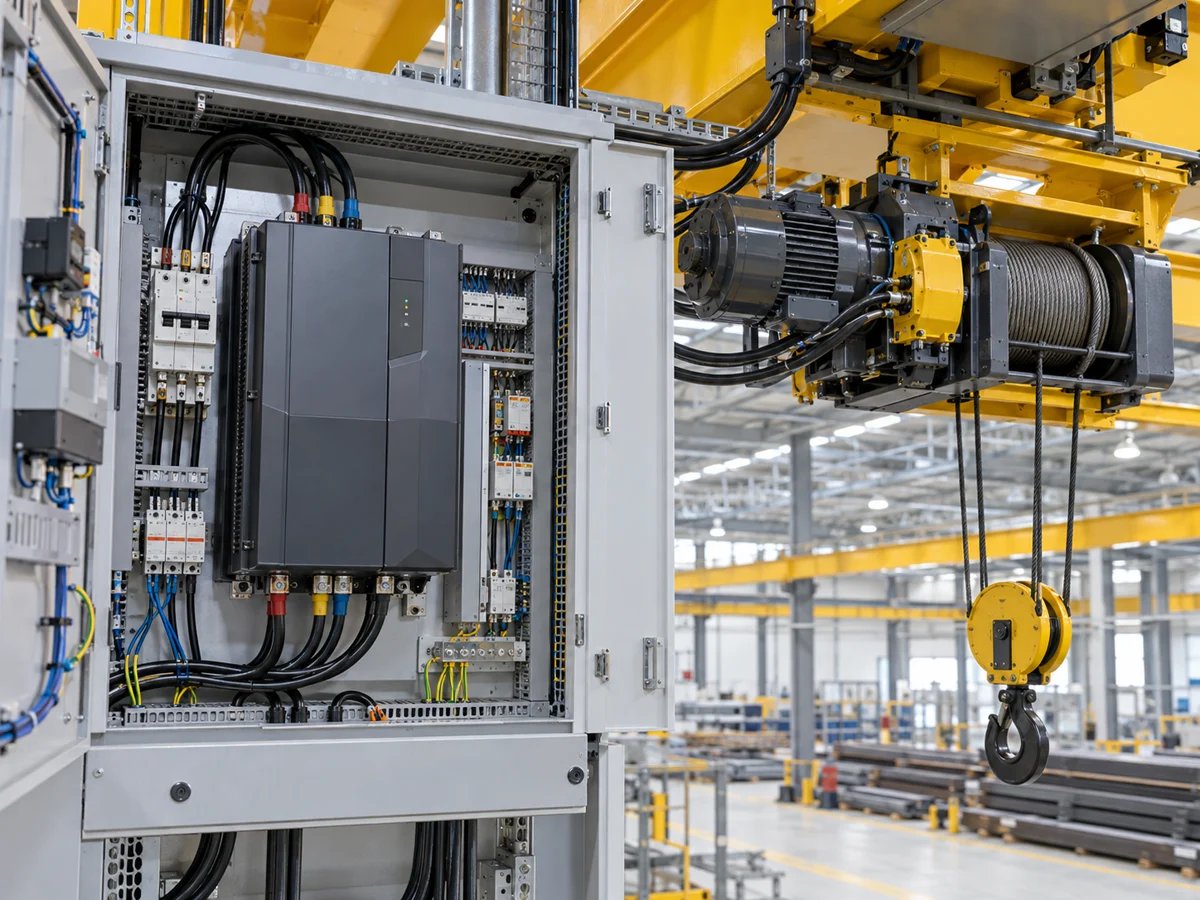
A suspended load changes the selection. The drive has to start the motor under a real load, run smoothly at lower speed when needed, coordinate with braking, and repeat the cycle many times. That is why FU9000H is separated from the general machinery series.
The starting condition matters because a lifting motor may already be carrying load when it receives the run command.
Crane and hoist duty can involve many start, stop and reverse cycles through the day. Duty information should be included with the motor data.
FU9000H uses hoist-oriented parameter functions and intelligent parameter setup to support crane and lifting applications.
For lifting work, low speed is not simply a comfort setting. The motor may need to move a suspended load smoothly while the operator positions it. The motor plate, load, gear ratio and required lifting speed all affect how the drive should be sized and tuned.
When the application needs very slow positioning, tell us the required speed instead of only giving the motor kW. It changes the selection conversation immediately.
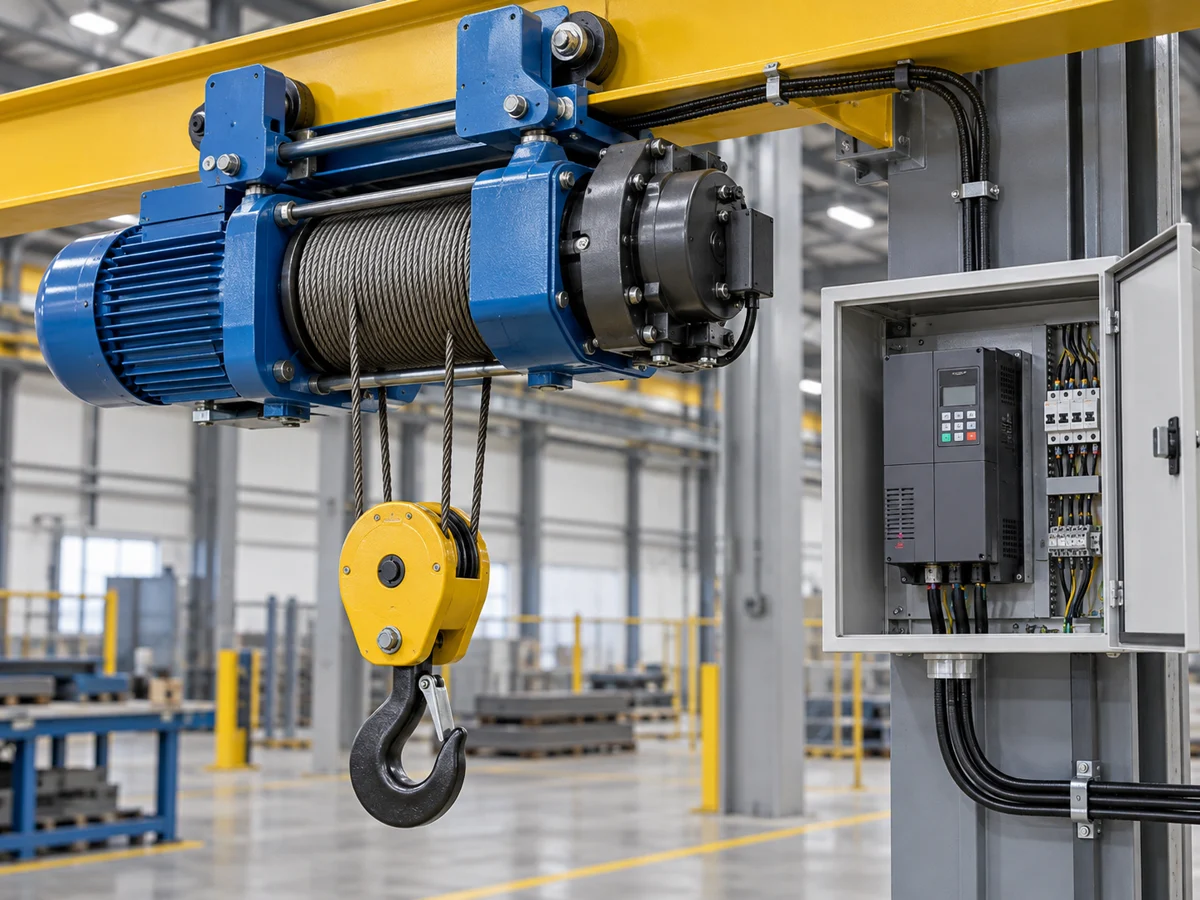
Crane work is not only about getting the motor to turn. The load also has to stop and hold safely according to the machine design. During a retrofit or new project, we ask how the mechanical brake is controlled, when it releases, and what stopping behavior the machine requires.
The drive should bring the motor up to speed without a hard mechanical shock to the lifting system.
Stopping time affects the electrical and mechanical braking discussion, especially with a suspended or high-inertia load.
The drive settings have to fit the machine’s brake logic. Send the brake voltage and control method with the inquiry when available.
A hoist may lift, stop, lower and start again in a short cycle. Travel motors can also reverse frequently. FU9000H is selected around that operating pattern rather than around motor power alone.
Tell us the load and lifting speed, not only the motor size.
Lowering can change the braking and energy-flow discussion. The machine duty should be reviewed before model confirmation.
For crane travel motors, include forward/reverse frequency and acceleration requirements.
Use the hoist motor and travel motor data separately when the crane has more than one drive function.
Low-speed positioning, brake logic and repeated lifting cycles should be reviewed together.
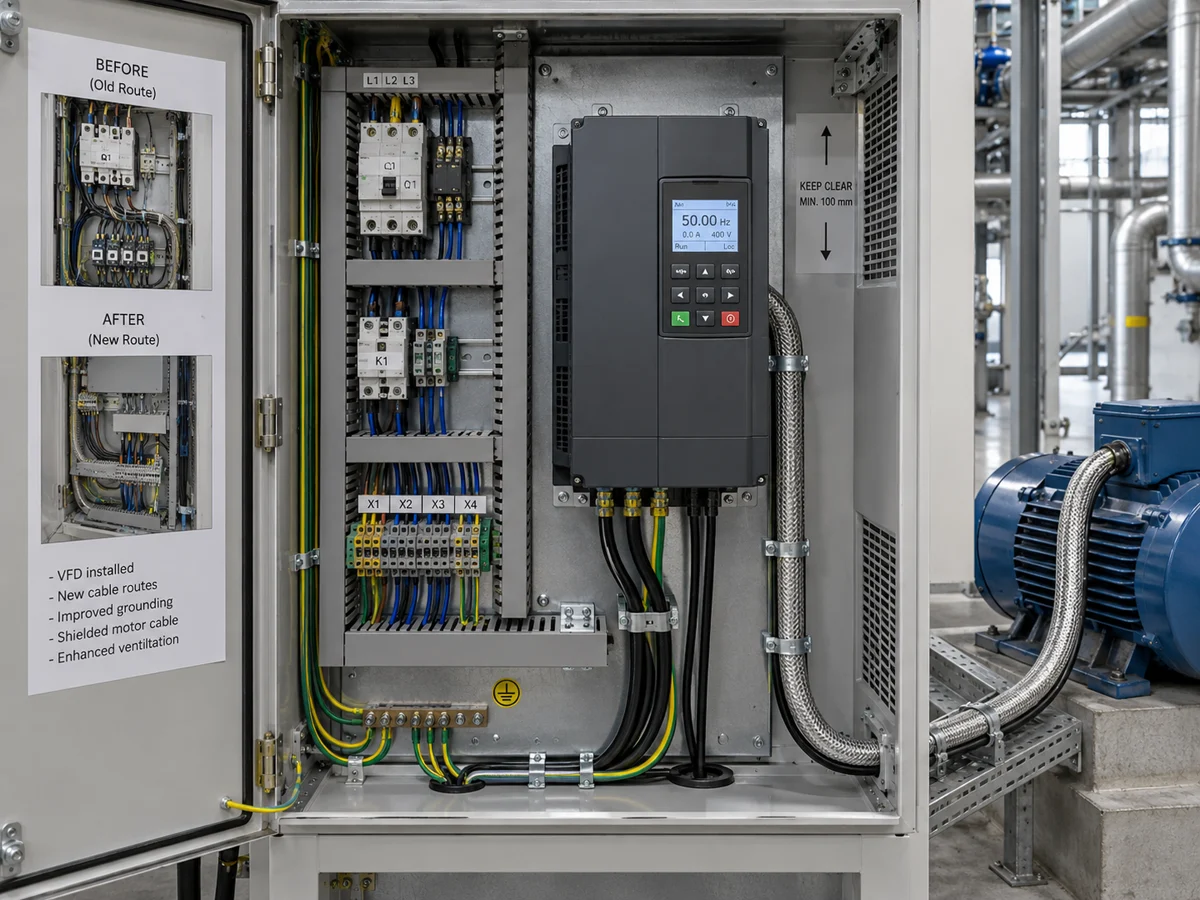
For an existing crane, the old drive photo and terminal wiring help us understand how the new drive must fit into the cabinet and control system.
| Data | Why we ask |
|---|---|
| Motor nameplate | Confirms power, current, voltage, frequency and motor speed. |
| Motor function | Hoist, trolley and bridge travel can have different operating duty. |
| Lifting load | Shows the real mechanical demand on the lifting system. |
| Lifting / travel speed | Helps us understand the required speed range and low-speed operation. |
| Starts per hour | Repeated duty matters more on lifting equipment than on many continuously running machines. |
| Mechanical brake | Brake voltage and control logic are part of the commissioning discussion. |
| Old drive and cabinet photos | Useful for retrofit dimensions, wiring and terminal planning. |
A crane can have several motors, and they do not all do the same job. The hoist motor handles the vertical load. Trolley and bridge motors move the load horizontally. The motor powers may look similar on paper, but the operating pattern, braking requirement and speed range can be different.
Send lifting load, lifting speed, brake information and the number of starts per hour. Low-speed positioning is often more important here than on the travel motors.
For trolley travel, acceleration, reversing and the required travel speed are useful selection data. Note whether the trolley usually moves with a suspended load.
Bridge travel may use more than one motor. Tell us the motor arrangement and how the existing controller commands the drives so the replacement plan is clear.
A crane that moves occasionally is a different job from one that cycles all day. Repeated starts, direction changes and braking place a different demand on the drive and the mechanical system. This is why we ask for the duty pattern instead of accepting only a motor nameplate.
If exact duty data is not available, a short description of the working cycle is still useful: how long the lift runs, how often it stops, whether it reverses under load, and whether the machine spends time at low speed. That gives us a better starting point for selecting FU9000H than motor kW alone.
If the application is ordinary machinery, FU9000D is usually the first general-purpose series to review. Once the job becomes a lifting application with a suspended load, repeated braking, low-speed positioning or frequent reversing, FU9000H becomes the more natural starting point.
This separation keeps the quotation focused on the real duty. It also helps avoid treating a crane motor like a normal continuously running machine motor.
FU9000H orders are checked against the approved model and order file before packing. Electrical and functional checks are part of the UFELE quality-control process. For a crane project, the order file should also make the application clear so the selected configuration matches the lifting duty discussed with the buyer.
Documents:
Use the current FU9000H datasheet and manual for the exact current, terminals, control functions and dimensions. Certificate scope should be checked against the selected model.
A lifting load starts, stops, reverses and brakes differently from many general machine loads. FU9000H is the UFELE series developed around repeated crane and hoist operation.
FU9000H covers 0.75 to 630 kW (1–850 HP) in 380 V and 480 V classes, with the exact model selected from motor and duty data.
Send the hoist or travel motor nameplate, lifting load, lifting speed, starts per hour, brake information and duty pattern.
Yes. Acceleration, stopping, lowering and repeated operation all affect the braking discussion. Include the mechanical brake and stopping requirement in the inquiry.
Yes, provided the old drive, motor, brake, control signals and operating duty are reviewed before the replacement model is chosen.
Those three items tell us far more than motor kW alone.