VFD and Motor Control
Drive sizing, motor data, load behavior, overload ratings and contactor duty.
UFELE Electric — Solar Pumping, Industrial Drives and PV Protection
Email: sale@ufele.com | B2B Supply and OEM Orders

Use these working definitions when comparing VFDs, solar pump inverters, PV protection devices and low-voltage products. Each entry explains the term and the detail a buyer should check before approving a model.
These concise explanations support product selection. They do not replace the applicable IEC standard, local electrical code, project design or current manufacturer datasheet.
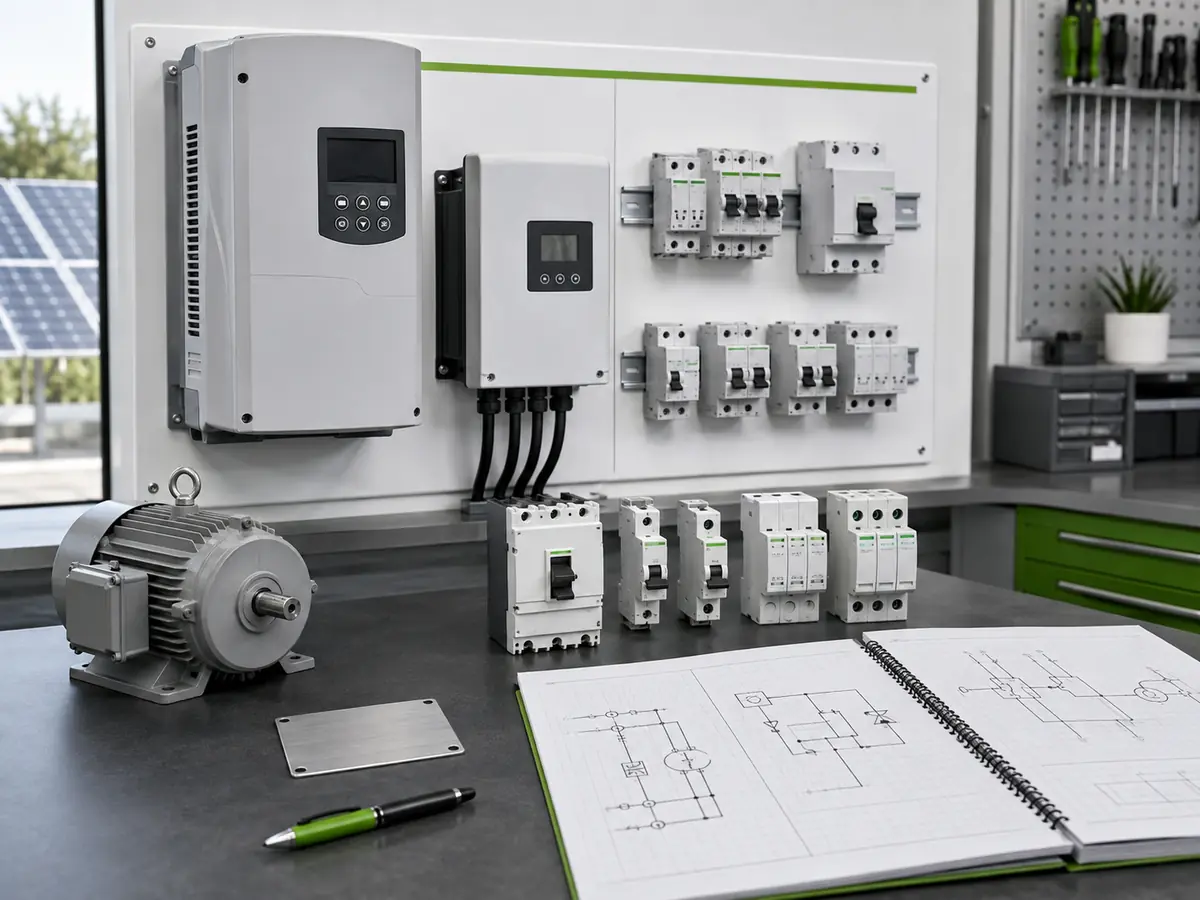
Motor control, solar pumping, PV DC protection and low-voltage protection use different ratings and selection checks.
Start with the system you are specifying. Every term has a stable anchor link, so you can send a buyer or engineer directly to one definition.
Drive sizing, motor data, load behavior, overload ratings and contactor duty.
PV electrical values, string design and solar pump inverter operation.
DC breakers, fuses, isolators, SPDs and combiner boxes.
MCB, MCCB, RCCB and RCBO selection and coordination terms.
Enclosure, temperature, altitude, poles and fault-current checks.
Official IEC sources used to define the scope of key protection terms.
Quick index: AC-1 / AC-3 · Breaking capacity · DC isolator · Derating · gPV fuse · IP rating · MCB · MCCB · MPPT · PV combiner box · RCCB · RCBO · SPD · VFD · Voc
Start with the motor and driven load. A drive nameplate kW value never replaces current, duty and environment checks.
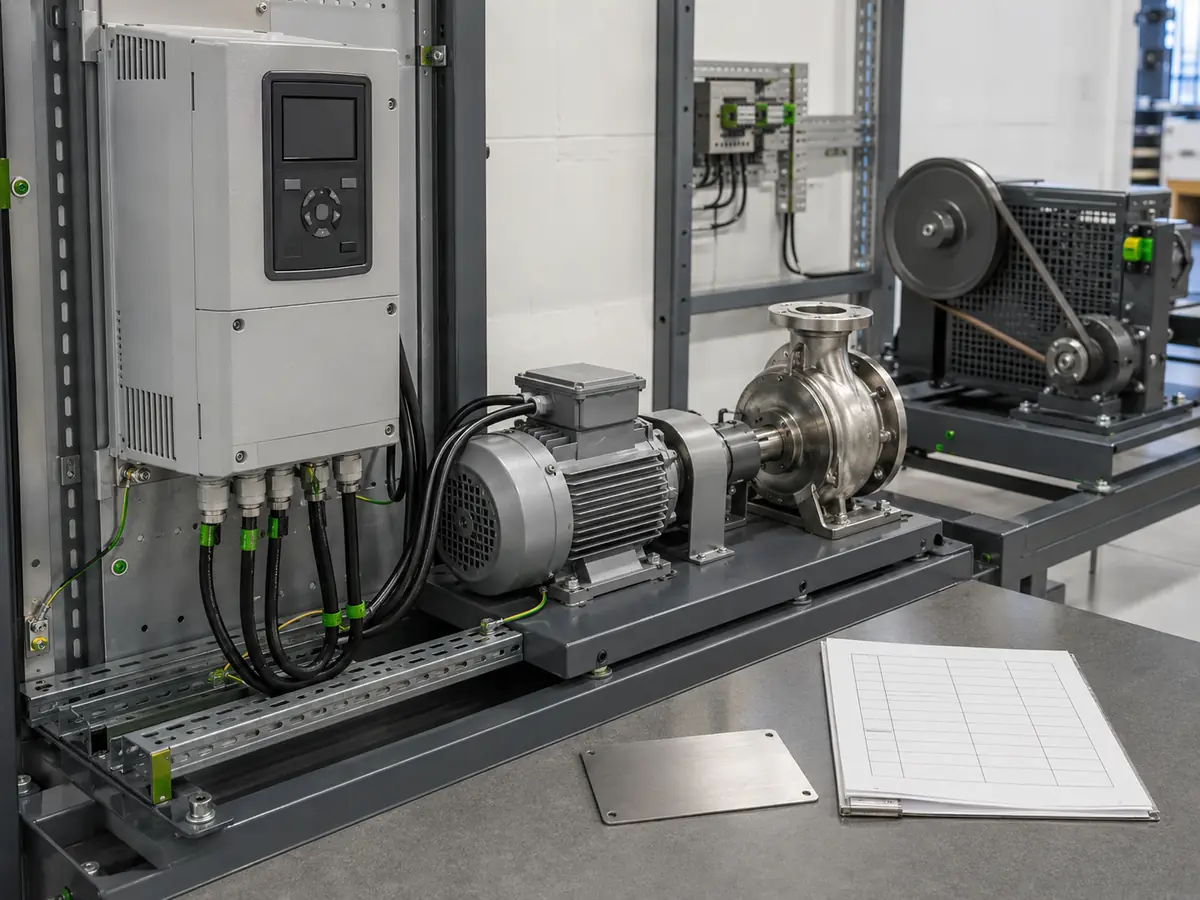
Meaning: Variable frequency drive. It controls AC motor speed and torque by varying output frequency and voltage.
Buying check: Match supply, motor rated current, load duty, overload and environment. Use our VFD range and VFD selection guide together.
Meaning: The motor nameplate current at a stated voltage, frequency and operating condition.
Buying check: Compare it with the VFD continuous output-current rating. Do not estimate current from motor kW when the actual nameplate is available.
Meaning: The motor label that records rated voltage, current, power, frequency, speed and other identification data.
Buying check: Send a clear full-label photo. Confirm which voltage connection and frequency apply to the intended supply.
Meaning: The torque, speed, starting and overload behavior required by the driven machine.
Buying check: State whether the motor drives a pump, fan, conveyor, mixer, compressor or lifting load. Equal-kW motors can require different VFD ratings.
Meaning: A load that needs broadly similar torque across much of its operating speed range. Conveyors and positive-displacement machines are common examples.
Buying check: Confirm breakaway torque, loaded starting and low-speed operation. Do not size it as a centrifugal pump simply because the motor kW matches.
Meaning: A load, commonly a centrifugal pump or fan, whose torque demand falls as speed decreases.
Buying check: Confirm the machine is truly centrifugal and check whether it starts against pressure, a closed valve or another abnormal condition.
Meaning: A drive rating for the overload profile stated as normal duty by that manufacturer.
Buying check: Read the overload percentage, duration and repeat interval. “Normal duty” is not one universal value across all VFD series.
Meaning: A drive rating for a more demanding overload profile than the same manufacturer’s normal-duty rating.
Buying check: Verify the heavy-duty output current, not only the enclosure label kW. One frame can carry different normal- and heavy-duty ratings.
Meaning: The temporary current a drive or switching device can carry for a stated time under stated conditions.
Buying check: Compare percentage, time and duty cycle. A short current peak and a prolonged overload are different selection cases.
Meaning: Contactor utilization categories. AC-1 applies mainly to non-inductive or slightly inductive loads. AC-3 relates to starting and switching squirrel-cage motors.
Buying check: Use the current rating for the actual utilization category. Do not substitute the usually higher AC-1 current for an AC-3 motor load.
Related guidance: How a VFD works · VFD basics · Repair or replace a VFD
PV voltage changes with temperature and operating condition. Keep open-circuit, maximum-power and current values separate.
Meaning: A drive that converts PV array power into controlled output for a pump motor and manages solar pumping functions.
Buying check: Match the motor, pump, PV string window, maximum DC input, protection plan and water-control inputs. See the solar pump inverter range.
Meaning: Maximum power point tracking. It operates a PV array near the voltage and current combination producing the maximum available power.
Buying check: Keep the expected operating string voltage inside the inverter MPPT range. Do not confuse the MPPT range with the absolute maximum DC input voltage.
Meaning: A set of PV modules connected in series. Series connection raises voltage, while string current follows the module and operating conditions.
Buying check: State module model, modules per string, parallel string count and lowest expected temperature.
Meaning: Open-circuit voltage. It is the PV module or string voltage with no load connected.
Buying check: Correct total string Voc for the lowest expected module temperature. Keep it below the inverter and protection-device voltage limits.
Meaning: Voltage at maximum power under stated test conditions.
Buying check: Use expected operating Vmp to check the MPPT window. Do not use Vmp in place of cold-corrected Voc for the maximum-voltage check.
Meaning: Short-circuit current from a PV module or string under stated test conditions.
Buying check: Use the design method required by the applicable code for conductor and protective-device calculations. Do not treat Isc as normal operating current.
Meaning: Current at the PV maximum-power point under stated test conditions.
Buying check: Use it to understand expected operating current. Keep it separate from Isc and from the inverter’s maximum input-current limit.
Meaning: Standard test conditions used to state comparable PV module electrical ratings.
Buying check: Treat STC values as reference ratings. Actual field voltage, current and power change with irradiance, cell temperature and losses.
Related guidance: Solar pumping system design · Pump nameplate details · Prepare a solar pump inverter inquiry
DC interruption depends on circuit voltage, polarity, time constant and device design. An AC marking does not prove DC suitability.
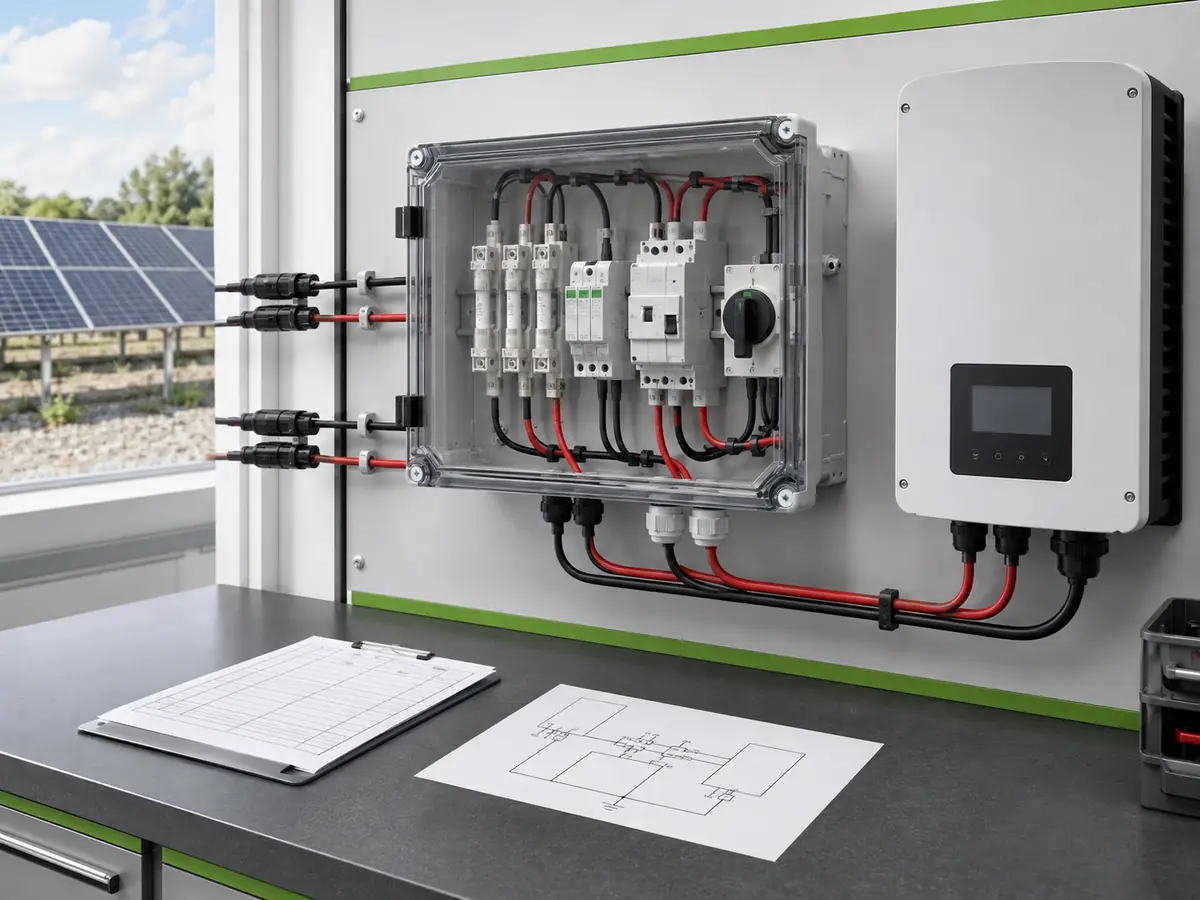
Meaning: A miniature circuit breaker designed and marked for specified DC circuits.
Buying check: Confirm rated DC voltage, current, poles, wiring direction where applicable, breaking capacity and circuit arrangement.
Meaning: A molded case circuit breaker with ratings and interruption performance specified for DC circuits.
Buying check: Confirm series-pole connection requirements, frame and trip ratings, breaking performance and application standard.
Meaning: A photovoltaic fuse-link utilization category intended for PV string and array protection.
Buying check: Match both fuse link and holder to current, DC voltage, breaking requirements, conductor protection and ambient conditions.
Meaning: A switch-disconnector used to isolate a DC circuit under its stated operating category and ratings.
Buying check: Confirm voltage, current, poles, utilization category, enclosure and whether load switching is required. An isolating function alone does not define overcurrent protection.
Meaning: Surge protective device. It limits transient overvoltage and diverts surge current.
Buying check: Match AC or PV DC use, system voltage, earthing arrangement, SPD type, Ucpv, Up and backup protection. Browse PV DC protection products.
Meaning: The maximum continuous operating voltage assigned to an SPD for a PV application.
Buying check: Coordinate it with the maximum expected PV array voltage and system configuration. Do not select only from the nominal array voltage.
Meaning: Voltage protection level. It indicates an SPD’s voltage-limiting performance under stated test conditions.
Buying check: Coordinate Up with the impulse withstand of protected equipment and keep connections short. A lower number alone does not complete SPD selection.
Meaning: An enclosure that combines PV string circuits and may contain isolation, overcurrent protection, surge protection and monitoring.
Buying check: State string count, Voc, Isc, output arrangement, device ratings, enclosure requirement and cable-entry plan. See PV combiner boxes.
Related guidance: Solar energy equipment · DC breaker, fuse and SPD checklist · PV combiner box buying guide
Device type is only the first filter. Current, poles, trip behavior, fault level and application standard decide whether a breaker fits the circuit.
Meaning: Miniature circuit breaker. It provides overcurrent protection with fixed or defined tripping characteristics.
Buying check: Confirm current, poles, voltage, frequency, trip curve, breaking capacity and application standard. Browse AC circuit breakers.
Meaning: Molded case circuit breaker. It commonly serves higher current, higher interruption duties or applications needing adjustable protection.
Buying check: Separate frame size from trip rating. Confirm voltage, poles, breaking ratings, trip unit and accessory requirements.
Meaning: A residual-current circuit breaker without integral overcurrent protection.
Buying check: Provide suitable overcurrent protection separately. Confirm poles, rated current, IΔn, RCD type, frequency and applicable standard.
Meaning: A residual-current circuit breaker with integral overcurrent protection.
Buying check: Confirm both functions: rated current and trip curve for overcurrent, plus IΔn and RCD type for residual current. Do not treat RCBO and RCCB as interchangeable.
Meaning: The prospective fault current a protective device can interrupt under stated conditions.
Buying check: Coordinate the correct rated short-circuit value with the calculated fault level at the installation point. Do not mix ratings from different standards or test conditions.
Meaning: The time-current behavior showing when an overcurrent protective device is expected to operate.
Buying check: Coordinate cable protection, normal inrush and fault clearing. Choosing a slower curve only to stop nuisance trips can leave the real cause unresolved.
Meaning: Also called discrimination. It aims to make the protective device nearest a fault operate while upstream protection remains closed when possible.
Buying check: Use manufacturer coordination data or an engineering study. A larger upstream current rating does not automatically prove selectivity.
Meaning: The assigned residual-current value at which an RCD must operate under specified conditions.
Buying check: Select IΔn with the protection objective, circuit leakage, local code and RCD type. It is not the same as the device’s rated load current.
Related guidance: Low-voltage electrical products · Low-voltage order checklist
Ratings assume stated reference conditions. Cabinet design, temperature, altitude and available fault current can change the final selection.
Meaning: Ingress protection code for stated protection against access, solid objects and water.
Buying check: Also review UV, corrosion, condensation, cooling and direct-weather exposure. An IP code does not cover these conditions by itself.
Meaning: A device path intended to open or control one conductor of a circuit.
Buying check: Match pole count and wiring to the earthing and circuit arrangement. Do not assume a pole can interrupt the full DC voltage without the stated connection method.
Meaning: A reduction in usable equipment capacity when operating conditions differ from rated reference conditions.
Buying check: Review the current datasheet for temperature, altitude, enclosure, carrier frequency, grouping and other applicable correction factors.
Meaning: The temperature of the surrounding medium in which equipment operates.
Buying check: State the expected air temperature around the device, not only the outdoor weather forecast. Cabinet temperature can be significantly higher.
Meaning: Installation height above sea level, which can affect cooling and insulation performance.
Buying check: Compare site altitude with the manufacturer’s reference limit and apply the stated derating or design changes above that limit.
Meaning: The current that would flow at one circuit point if a negligible-impedance short circuit occurred there.
Buying check: Calculate or obtain the value at the installation point. Coordinate it with device breaking capacity and the complete protection scheme.
Related pages: Quality control · OEM and custom service · Send installation details
UFELE uses manufacturer data, project requirements and applicable standards together. The references below define the scope of several common terms. Always verify the edition and local adoption required for the destination market.
IEC guidance on IP ratings explains the solid-object and water-protection code associated with IEC 60529.
IEC 60947-2:2024 covers circuit breakers within its stated voltage and application scope.
IEC 61008-1:2024 addresses RCCBs without integral overcurrent protection. IEC 61009-1:2024 addresses RCBOs with integral overcurrent protection.
IEC 61643-31:2018 covers requirements and test methods for SPDs used in photovoltaic installations.
IEC 61643-32:2017 describes PV SPD selection, installation and coordination principles.
IEC 60947-3:2020+A1:2025 covers switches, disconnectors and switch-disconnectors within its stated scope.
A reference to a standard does not claim that every UFELE product is certified to every edition or destination-market requirement. Confirm the exact model, rating, certificate scope and required edition before order approval.
No. Use motor rated current, supply voltage, load duty, required overload, operating environment and the current data for the selected VFD series. Motor kW is only a starting reference.
An RCCB provides residual-current protection but does not include integral overcurrent protection. An RCBO combines residual-current and overcurrent protection. Always confirm poles, current ratings, residual-current type, breaking capacity and the applicable standard.
Use the total series string open-circuit voltage and correct it for the lowest expected module temperature. The corrected value must stay below the inverter’s stated maximum DC input voltage and within the limits of the connected protection devices.
No. An IP rating addresses stated access, solid-object and water protection. It does not by itself confirm UV resistance, corrosion resistance, condensation control, cooling performance or suitability for direct weather exposure.
Send the model label, motor nameplate, PV module datasheet or single-line drawing. We will identify which values affect selection and which details still need confirmation.