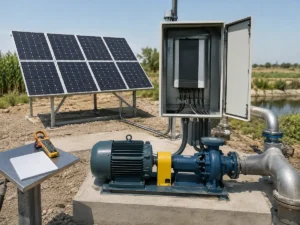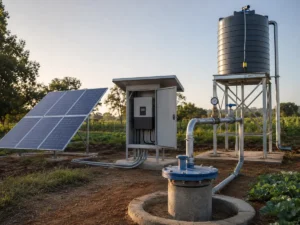
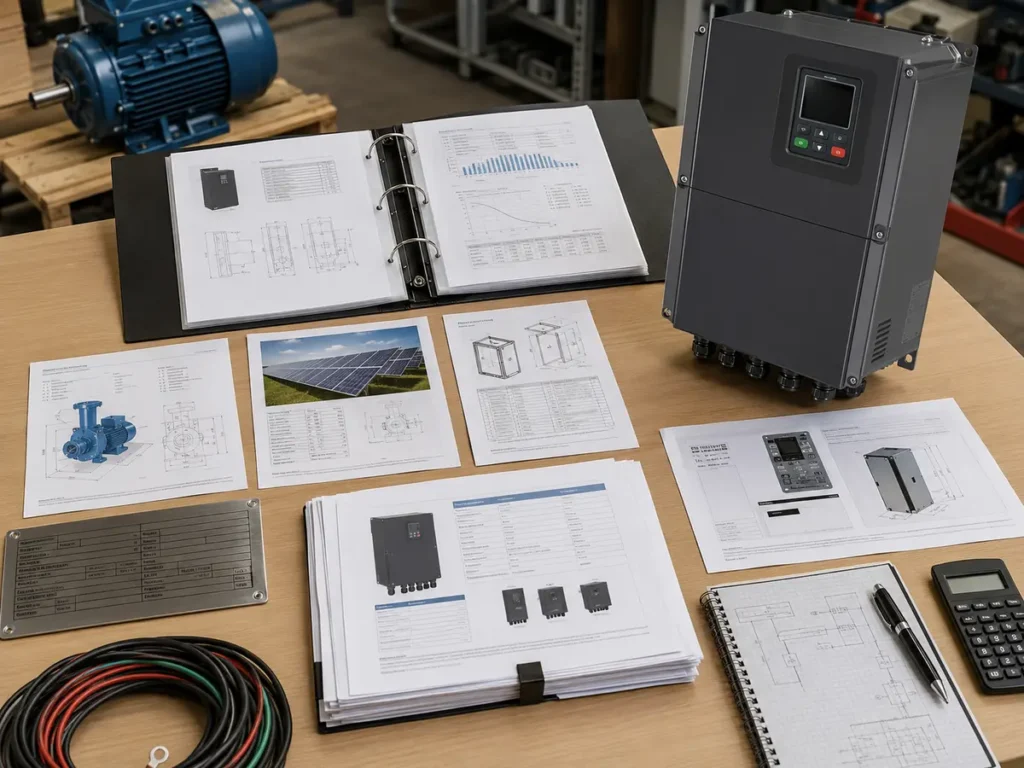
A low quotation looks convincing right up until someone asks the supplier to match it against real numbers — pump current, PV string voltage, how the unit derates on a hot roof, the enclosure, the protection logic, the paperwork. This guide walks through what to check before a solar pumping order moves past the price-comparison stage.
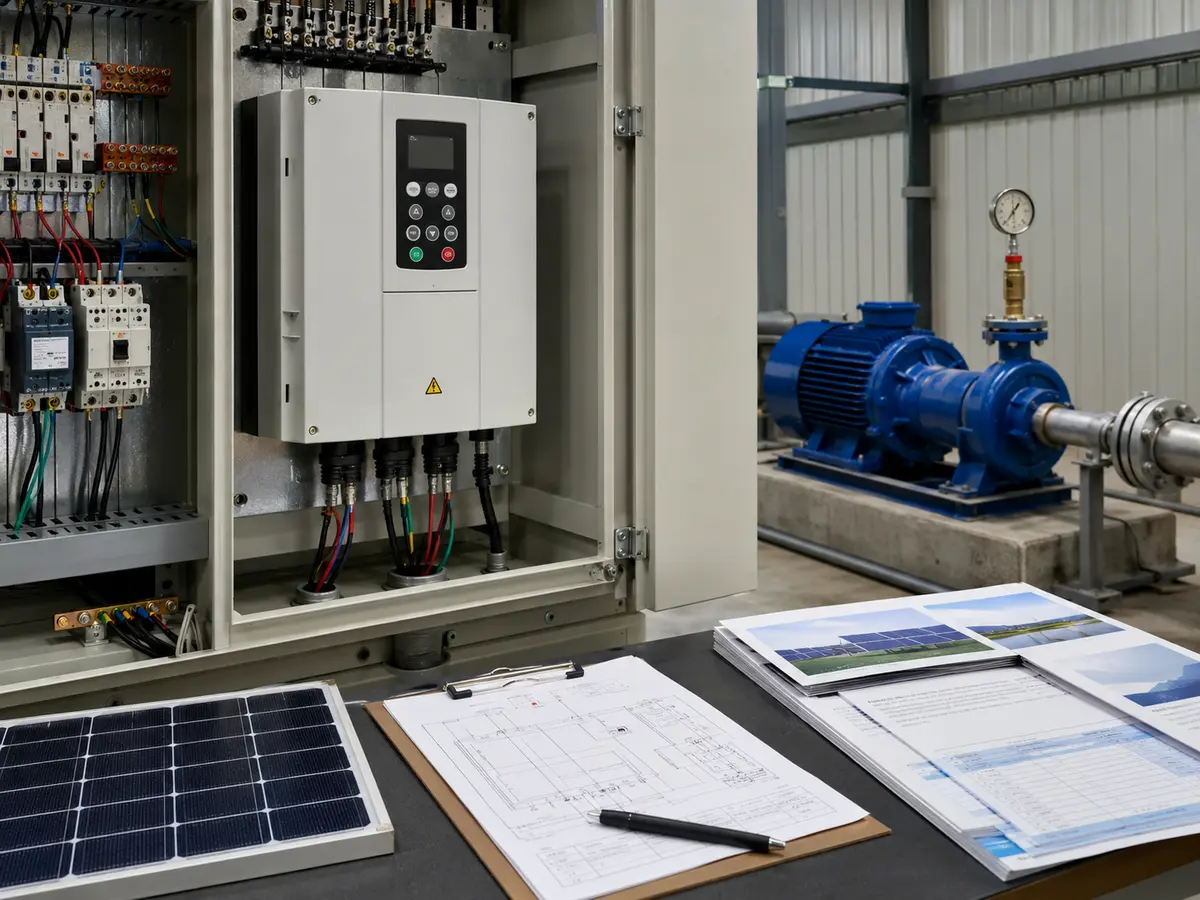
What should buyers check in a solar pump inverter manufacturer?
Start with how the supplier reviews your application, not with the catalogue cover. Can they land on one exact inverter model? To do that, they need the pump’s voltage, phase, current, power, head and flow, plus the PV module data, site temperature, altitude, cable length, enclosure, control signals, and your backup-power plan. Next, check the rating table, MPPT window, and maximum DC input voltage. Then pull the protection functions, derating rules, test records, certificate scope, labeling, and manuals, and confirm they all match. Finally, look at the warranty route, MOQ, lead time, and spare-part support. Every one of these should trace back to the same model code and revision — if they don’t, that’s the first red flag.
Two offers can use the same words—MPPT, dry-run protection, IP65, remote monitoring—and still represent very different levels of work. One supplier may select a model from pump kW alone. Another may stop because the motor current is missing or because the proposed PV string sits too close to the inverter’s cold-weather voltage limit. That pause is not poor service. In fact, it often shows that someone has noticed where the project can fail.
This is not a ranking of solar pump inverter manufacturers. A list cannot know the pump on your project, the destination market, or whether you need ten standard units or an OEM program with approved labels and manuals. Instead, the useful question is narrower: which supplier can turn your project data into a model, a documented order, and support that still makes sense when the equipment reaches the site?
The manufacturer guide sits above the detailed calculation. If you haven’t checked the pump and PV array yet, use our solar pump inverter sizing guide. Buyers who are still defining the complete installation can also review the solar pumping system page before comparing suppliers.
1. See how the supplier handles an incomplete application
A strong first reply does not need to be long. It does need to expose missing information. Suppose an inquiry says only “15 kW solar pump inverter, three phase, 30 pieces.” I would not expect a final model from that line. I would expect questions about the site supply, pump motor voltage and current, pump duty, PV module Voc and Vmp, modules per string, the lowest expected temperature, enclosure, and whether the project needs grid or generator backup.
Watch what happens when your data conflict. A pump plate may show 380 V while the buyer writes 220 V in the email. The module count may exceed the inverter’s cold-condition DC limit even though its nominal string voltage looks acceptable. Someone may plan to mount the proposed IP20 unit on an exposed outdoor wall. A supplier who silently chooses the nearest kW creates a clean quotation and transfers every unresolved point to commissioning.
Ask the supplier to show the selection basis. It can be a short worksheet, an annotated rating table, or a clear email. The form matters less than the chain of reasoning. You should see which pump current they used and which DC voltage limits they checked. What derating applies, and what’s left for the customer or pump supplier to confirm, should also be clear.
2. Check whether the product range fits the project, not just the headline power
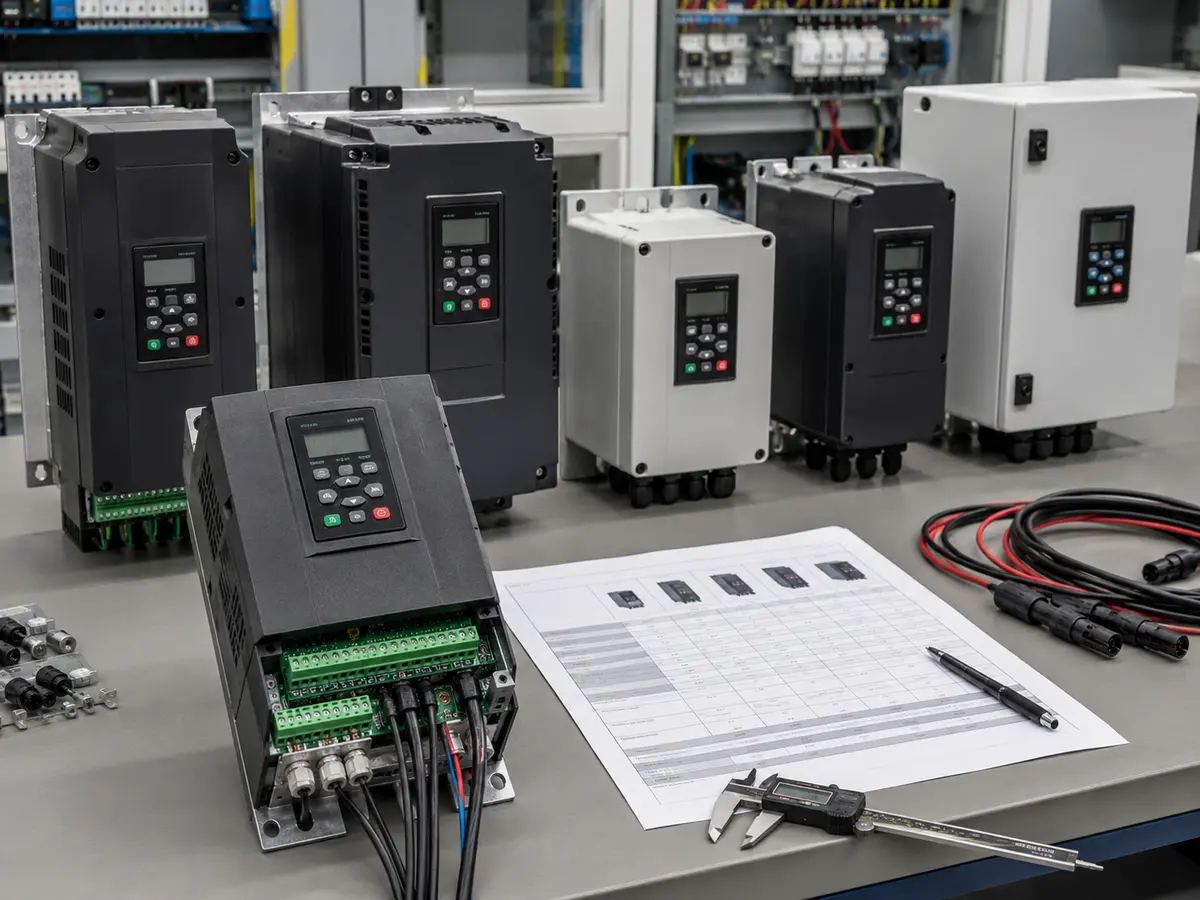
“0.75–200 kW” tells you the family span. It doesn’t prove that every voltage, enclosure, MPPT range, backup function, communication option, or certification shows up at every power point. So ask for the exact model table. Then locate your voltage class and continuous output current rather than relying on the motor-kW label alone.
A useful solar pump drive should publish the input and output conditions clearly. For example, on the DC side, look for the recommended MPPT range and absolute maximum input voltage. On the motor side, confirm the permitted output voltage, phase, current, frequency range, and motor types. Review overload, carrier-frequency derating, ambient-temperature limits, altitude, motor-cable guidance, and any reactor or filter recommendation.
Pump functions need the same discipline. Dry-run protection can rely on current, power, a sensor, or another inferred condition. Tank-full control may use a float switch, level probe, or digital input. Sleep and wake thresholds can behave differently between firmware versions. Ask the supplier to walk you through how they wire and set each function on the offered model. After all, a feature name in a brochure is not yet a commissioning method.
| Supplier claim | Evidence to request | Common review problem |
|---|---|---|
| Wide power range | Exact model and current table | The required voltage or enclosure is missing at that power |
| High-efficiency MPPT | MPPT range, maximum DC voltage, and test conditions | A percentage is shown without the operating condition |
| Dry-run and tank-full protection | Manual pages, wiring, and parameter logic | The function needs a sensor or firmware option not quoted |
| Outdoor installation | IP rating, mounting rules, derating, and environmental limits | IP protection is treated as a substitute for shade and cooling |
| Grid or generator backup | Supported architecture and switching logic | AC and DC sources are shown without an approved operating sequence |
| Remote monitoring | Hardware code, protocol, platform terms, and data map | Communication is optional or depends on a separate service |
3. Don’t judge the product by the datasheet alone
A polished datasheet tells you the supplier can design a PDF. It doesn’t tell you much else. Ask for the installation manual next, and check that its model family and revision actually line up with what the supplier quoted. A manual worth trusting covers the terminals and wiring, clearances, grounding, the protection devices, how you set parameters, fault codes, and maintenance steps. It should also say — this one’s easy to forget — how long to wait after you cut the power before it’s safe to open the unit.
Also look for differences between the sales sheet and the manual. For instance, the datasheet may say “RS485” while the manual identifies Modbus RTU only. An image may show a DC isolator that the model does not include. The IP65 version may have different terminals or ventilation requirements from the IP20 cabinet version. These are not minor editing issues once the buyer has designed a panel, cable schedule, or field installation around them.
Firmware deserves a place in the approval file when it changes pump behavior. Record the version if the project depends on a specific sleep/wake sequence, water-level input, dual-source logic, communication map, or motor-control function. For repeat orders, ask whether the same version will stay available and how the supplier communicates changes.
It also helps to request editable or high-resolution files before an OEM order: dimension drawings, terminal diagrams, label templates, manual source files where agreed, carton marks, and barcode positions. Approve them by revision. A logo pasted into a brochure is not the same as a controlled OEM file.
4. Ask what is tested and how the result follows the serial number
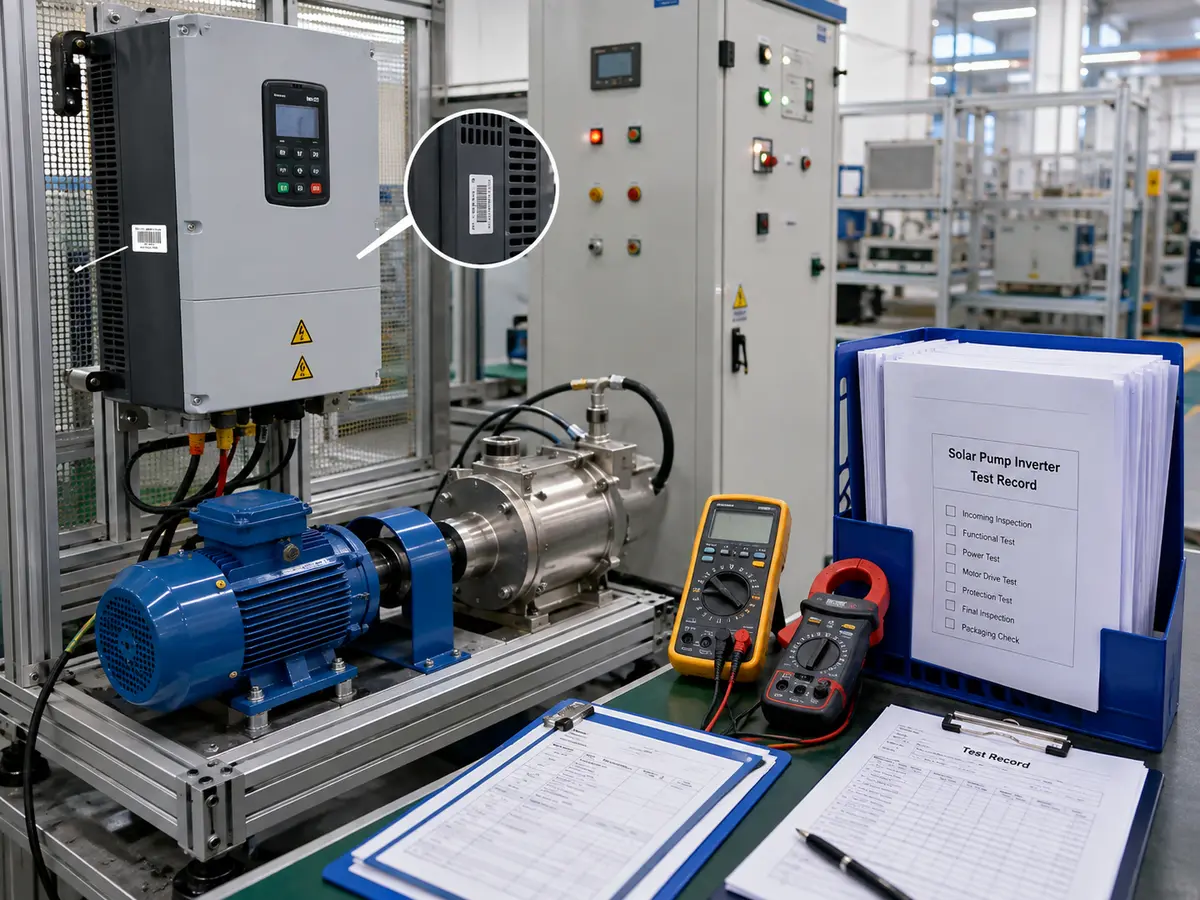
“100% tested” sounds reassuring, but the next question matters more: tested for what? A factory may check power-on, keypad, display, fan, communication, I/O, output voltage, protective trips, and loaded operation. Another may perform only a short functional check. Either way, ask for the inspection items, the acceptance limits, the sampling plan where it applies, and the record kept for the shipped batch.
A solar pump inverter test should reflect its electrical job. The manufacturer may verify input and output functions on controlled equipment, run a motor or pump-related load, check MPPT or DC-input behavior with a suitable source, and confirm protection responses. The exact test arrangement varies by model and production stage. Buyers should not assume that an aging rack proves every field condition. So ask which functions get a production test and which ones the supplier only validated during design qualification.
Traceability becomes important after delivery. Can the supplier connect a serial number or batch code to production date, firmware, inspection record, and component or process changes? If a fault appears in several units, that trail is more useful than a general promise to “check with the engineer.”
5. Verify certificates against the exact model and destination market
A certificate logo on a homepage should never finish the review. Instead, request the declaration, certificate, or test report relevant to the destination and product. Check the applicant or manufacturer name, factory address where relevant, model list, ratings, referenced standard, issue date, validity or status, and issuing organization. Also check that the suffix on your quotation shows up on the certificate itself — don’t assume one family certificate covers every variant.
What the standards actually cover
On the safety side, you’ll likely run into IEC 61800-5-1 or a national equivalent of it. IEC’s own listing covers electrical, thermal, fire, mechanical, energy, and other hazards under this standard for adjustable-speed power drive systems — worth knowing so you’re asking the right question rather than a vague one about “certification.” EMC sits under a different standard, IEC 61800-3:2022, which handles EMC requirements and test methods separately. None of this replaces checking what your destination market actually requires; the standards give you the vocabulary, not the final answer.
Treat IP ratings the same way. IEC 60529 is what classifies how an enclosure resists dust and liquids — that’s it, that’s the whole scope. An IP65 badge on the box doesn’t mean the drive can sit in direct sun, ignore condensation, shrug off corrosive gas, or skip proper cable glands and mounting orientation. Ask, specifically, whether the rating covers the complete delivered enclosure and fittings, not just the tested sample.
And ISO 9001 — useful for judging how a supplier runs its operations, but it says nothing about the product itself. Per ISO, the standard sets out requirements for a quality-management system, and ISO itself doesn’t hand out the certifications — third-party bodies do that. So look up who actually issued it and what scope they signed off on, then go back to the product files and the order controls, because that’s where the real answers live.
Three separate questions, not one
6. Put customization, MOQ, and approval responsibility in writing
For a distributor, customization may begin with a logo and carton. But before long it’s spread to the nameplate, keypad overlay, manual, warranty card, terminal labels, color, firmware defaults, passwords, barcodes, plugs, cable glands — the accessories, too. Sort out early which of these are standard swaps, which need an engineer to sign off, and which ones could touch certification or testing without anyone noticing.
MOQ should track the customization level. A manufacturer may accept a small quantity in standard UFELE branding while requiring more units for private labels, printed cartons, color changes, or firmware work. Tooling, printing setup, component purchasing, test fixtures, and document preparation can all change the minimum. So a useful quotation separates these costs rather than hiding them in one unit price.
Sample approval needs its own rule. First, confirm whether the sample represents the production hardware, firmware, label, manual, accessories, and packing. Record any exceptions. If you only approved a generic sample for electrical function, don’t let that signature double as approval for an OEM label nobody has reviewed yet.
For repeat orders, keep the approved model code, bill-of-material or revision reference where available, firmware, artwork, carton specification, accessories, and test requirements together. Also, if a component substitution becomes necessary, agree on the notification and approval path before production. Our OEM electrical product service page explains how UFELE handles labels, packing, and approval files.
7. Test technical support before the first bulk order
Support is easier to evaluate with a specific question than with “Do you have engineers?” Start by sending a pump plate, array plan, site temperature, cable length, and control requirement. Then ask the supplier to return the selected model and identify open points. A useful answer separates what they’ve confirmed, what they’re assuming, and what still needs evidence.
Then test the commissioning route. Who answers when the drive shows undervoltage, overcurrent, dry-run, or a communication fault? What photographs, videos, parameter exports, or measurements should the installer collect? Will they send the actual manual page and a proper parameter list, or just a screenshot that doesn’t quite match your model?
Time zones and language barriers are real, but they matter less than whether the answers are actually clear. Pin down a support contact, a realistic response window, and who you escalate to when the first answer doesn’t solve it. If you’re a distributor, it’s worth asking upfront whether training material, fault-code sheets, spare keypads, fans, communication modules, or replacement units come with the deal. Also define the warranty start point, excluded conditions, return evidence, freight responsibility, and whether field replacement or factory analysis is the normal remedy.
8. Compare total order risk, not only the inverter price
Match the scope before you compare the number
The lowest unit price may exclude the items that make the unit usable: DC isolator, communication module, keypad extension, reactor, filters, cable glands, spare parts, custom printing, test documents, or export packing. So place every quotation into one scope table. If one supplier priced an indoor IP20 unit and the other quoted an outdoor-rated one, that price gap isn’t telling you anything about who’s the better supplier — it’s just telling you they quoted two different products.
Terms carry cost too, not just line items
Payment terms, lead time, warranty, documentation, after-sales handling — all of it has a cost attached, even when it’s not on the invoice. For example, a promised fifteen-day lead time may start after artwork and deposit approval, not from the inquiry date. Certification copies may be available for standard models but require review after an OEM model-code change. Record these conditions before comparing totals.
| Review area | Supplier A | Supplier B | Decision evidence |
|---|---|---|---|
| Application selection | Model chosen from kW | Pump, PV, and site data checked | Signed selection sheet and open-point list |
| Quoted scope | Base inverter only | Options and exclusions separated | Line-by-line commercial offer |
| Technical files | General brochure | Matching datasheet and manual revision | Approved document register |
| Testing | “100% test” statement | Items, limits, and batch records identified | Inspection plan and sample report |
| Certification | Logos on website | Exact models and standards cross-checked | Certificate or report file with scope |
| OEM control | Logo accepted by email | Label, manual, carton, and revision approval | Approved artwork and sample record |
| After-sales | General warranty promise | Fault evidence and escalation route defined | Warranty terms and support contact |
Don’t force every row into a number if the evidence is still missing. In fact, a blank cell can be more honest than a score of eight out of ten based on a sales promise. So close the open points first, then compare.
Where UFELE fits in a manufacturer comparison
UFELE Electric is the export brand of UsFull Electric Co., Ltd., based in Wenzhou, Zhejiang, China. The company has operated since 2005, supplying products for solar pumping, motor control, PV protection, low-voltage applications, and OEM electrical orders. Buyers can review the current solar pump inverter range, then send the pump and project data for model review.
We do not treat a broad family range as approval for every application. The quotation still needs the pump voltage and current, PV string design, expected temperature, altitude, enclosure, control logic, cable length, and backup requirement where applicable. If a nameplate is unclear or the PV data do not support a safe voltage check, we would rather ask before the order moves forward.
For due diligence, use the UFELE factory, quality-control, certificate, and download pages as starting points. Then request the exact documents for the model and market under review. A company page introduces the supplier — the order file has to spell out exactly what they’ll produce and deliver.

What to send before requesting a final quotation
Begin with a clear pump and motor nameplate photograph plus the full model. Add rated voltage, phase, current, power, frequency, speed, maximum head, rated head, flow, well depth or water-source details, and the operating schedule. If a pump curve is available, include it. Our pump nameplate guide explains why motor kW alone can’t stand in for head and flow.
For the array, send the PV module datasheet, module quantity, planned series and parallel arrangement, Voc, Vmp, Isc, Imp, temperature coefficients, and the lowest expected site temperature. State whether the project uses DC solar only or needs grid or generator backup. Include ambient temperature, altitude, dust, rain, humidity, cabinet or wall mounting, motor-cable length, pipe arrangement, and any level, pressure, or flow sensors.
Commercial details complete the request: quantity, destination country, required standards or approval evidence, branding, label language, manual language, packing, accessories, spare parts, target delivery, and Incoterm. Ask the manufacturer to return the exact model, continuous output current, MPPT range, maximum DC voltage, enclosure, derating conditions, options, document list, MOQ, sample terms, lead time, warranty, and exclusions.
Manufacturer evaluation checklist
- The supplier asks for pump, PV-array, and site data before final model approval
- The quotation identifies a complete model code, duty rating, enclosure, and options
- Output current and DC voltage limits are checked under actual conditions
- Required pump functions have wiring and parameter instructions
- Datasheet, manual, drawings, firmware, and label refer to the same product revision
- Production tests, batch records, and serial-number traceability are explained
- Certificates and reports cover the relevant models, standards, and destination needs
- OEM scope, MOQ, sample approval, and change control are written down
- Lead time starts, payment milestones, packing, and exclusions are clear
- Commissioning, warranty evidence, escalation, and spare-part routes are defined
Send this file through the UFELE contact page. We’ll review the technical inputs first and show you which points still need confirming before a solar pump inverter quotation turns into an order-ready selection.
Frequently asked questions
How do I compare solar pump inverter manufacturers?
Give each supplier the same pump, PV, site, control, quantity, destination, and OEM file. Compare the exact model, current, DC voltage limits, derating, function evidence, test records, document scope, total quotation, and support route.
Is the lowest solar pump inverter price usually the best offer?
No. First normalize voltage class, current, enclosure, accessories, communication, backup functions, documents, packing, warranty, and delivery terms. A lower price may represent a smaller scope or a different rating basis.
Which certificates should a solar pump inverter manufacturer provide?
The answer depends on the destination and project. Ask for the declaration, certificate, or test report relevant to the exact model, ratings, referenced standard, manufacturer, and market rather than accepting website logos alone.
Does ISO 9001 prove that a solar pump inverter is certified?
No. ISO 9001 concerns the organization’s quality management system. Product conformity, safety, EMC, and destination-market requirements need their own applicable evidence.
Can a manufacturer select the inverter from pump kW only?
No. Pump voltage, phase, rated current, duty, head, flow, PV string data, temperature, altitude, enclosure, cable length, and control requirements can all change the selection.
What should I approve before a private-label order?
Approve the exact hardware and firmware, nameplate, keypad artwork, manual, carton, barcode, accessories, sample exceptions, test requirements, and revision record before bulk production.