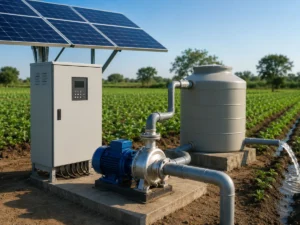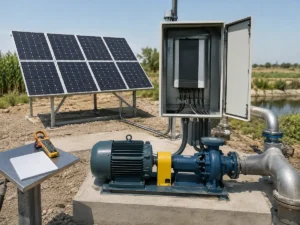
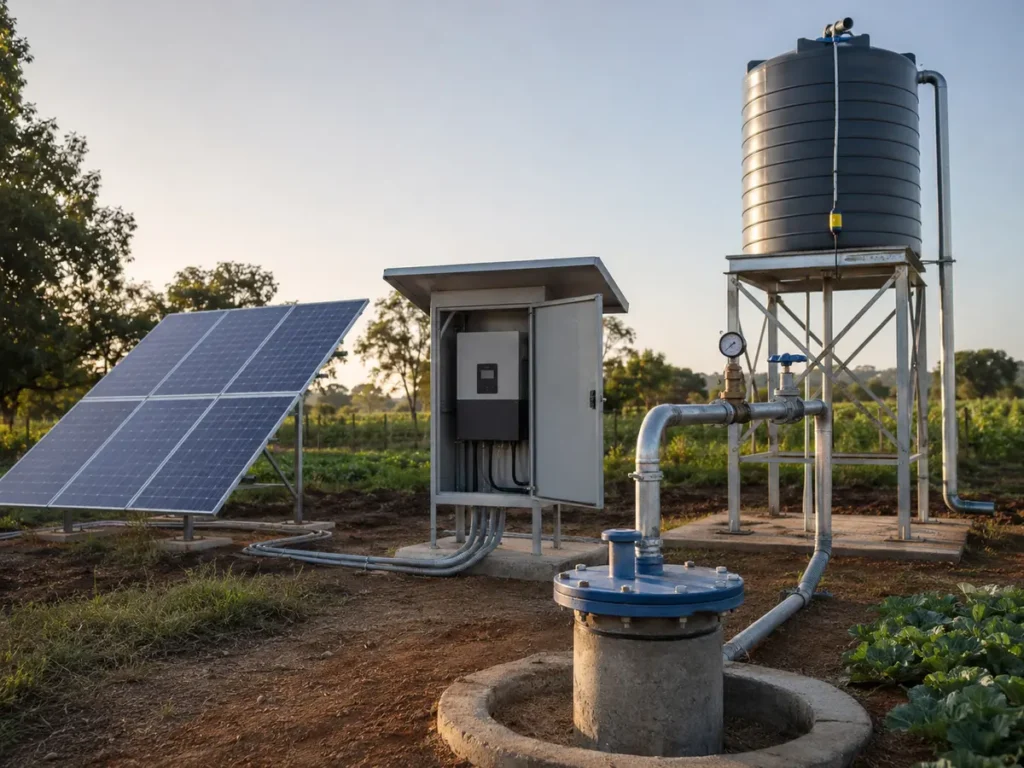
At first glance, a solar pump enquiry with panels, an inverter, and a pump seems almost complete. We understand why buyers begin there; those are the three products everyone can see. The gaps usually appear when someone tries to draw the connections. The water source, pipe route, tank controls, cables, and protection all need an answer before the equipment can work together at site.
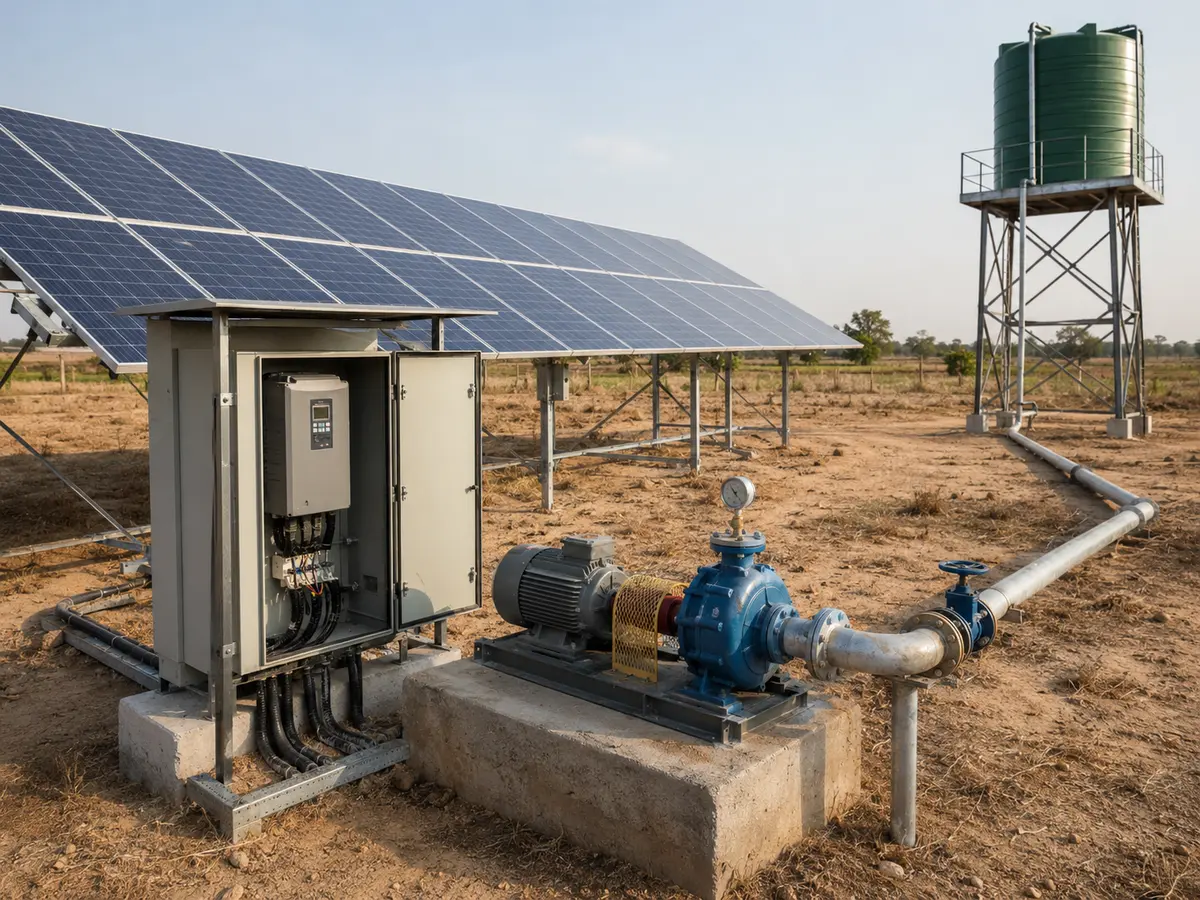
What are the main components of a solar pumping system?
Most people can name the large solar pumping system components without checking a drawing: PV modules and their frame, the pump inverter, motor, pump, power cable, and delivery pipe. It is usually a modest-looking item that causes the awkward call from site. The installer may have no local isolator, no dependable way to stop a dry well, or a float switch that does not suit the tank. Add pressure instruments, surge protection, or backup power when the duty calls for them, not simply because they appeared on another project’s list.
This is where a tidy product list can become misleading. Every item may be good on its own and the system may still disappoint. The PV string has to suit the inverter input. The inverter has to carry the motor current. The motor and pump then have to deliver water against the head that actually exists, not the head someone guessed during an early phone call. One weak connection between those parts is enough to spoil the result.
For that reason, a buyer should not treat a bill of materials as a shopping list assembled from catalogue headings. The useful document is a system schedule. It records the duty point, electrical ratings, cable lengths, environmental conditions, control logic, and responsibility for every item. UFELE’s solar pumping system page covers the complete application. This article looks more closely at what each component does and what information belongs beside it.
Begin with the water duty, not the component list
Panel wattage gives a buyer something concrete to compare, so it often appears near the top of the enquiry. We still put that number aside for a moment and look at the water. A borehole level may sink once pumping begins. Irrigation pipework may keep asking for pressure long after a tank-filling line would have done its job. The daily volume is useful, but it cannot choose the pump on its own. We need the flow, lift, drawdown, pipe loss, outlet pressure, seasonal level, and available pumping hours before the duty starts to feel believable.
Vertical lift can look harmless in a spreadsheet and still leave too little water at the outlet. A long run of narrow pipe quietly uses up head, and finding that out after the trench is closed is the sort of avoidable result nobody is happy to explain. For a borehole, one resting-level figure is not enough; the pumping level tells us how the source behaves under load. We also want a plain account of the water itself. Sand or sediment may call for a different strainer or filtration plan, while saline or corrosive water can change the acceptable pump materials. Those details deserve attention before anyone settles on an inverter.
Site information to collect first
- Project location and the month with the most difficult water demand
- Water source, minimum water level, drawdown, and borehole diameter
- Daily water volume, target flow, vertical lift, and discharge pressure
- Pipe length, internal diameter, fittings, and expected friction loss
- Water quality, sediment risk, and permitted pump position
- Storage capacity and periods when water must be available
Grundfos uses project location, daily water requirement, and total dynamic head as core inputs in its official solar water pumping selection process. It also recommends choosing the critical month, since water demand and available sunlight do not always peak together.
1. PV array and mounting structure
Motor kW does not tell us how many modules belong in a string. If the modules become hot, their operating voltage falls; the inverter still needs enough voltage to work properly. On a cold, bright morning, Voc moves the other way and must stay below the inverter’s absolute DC limit. Both checks matter. Passing one and ignoring the other is not a safe compromise. Once the voltage window is sound, we can judge current, array power, and the likely daily water yield.
A module described only as “550 W” is not enough for this work. Keep its data sheet beside the calculation and read Vmp, Imp, Voc, Isc, and the voltage temperature coefficient from that exact model. Series modules build voltage; parallel strings add current. The arithmetic is straightforward, but the decision still depends on local temperature and the input limits of the exact inverter. STC values are useful reference numbers, not a promise of what the array will produce on the roof or in the field.
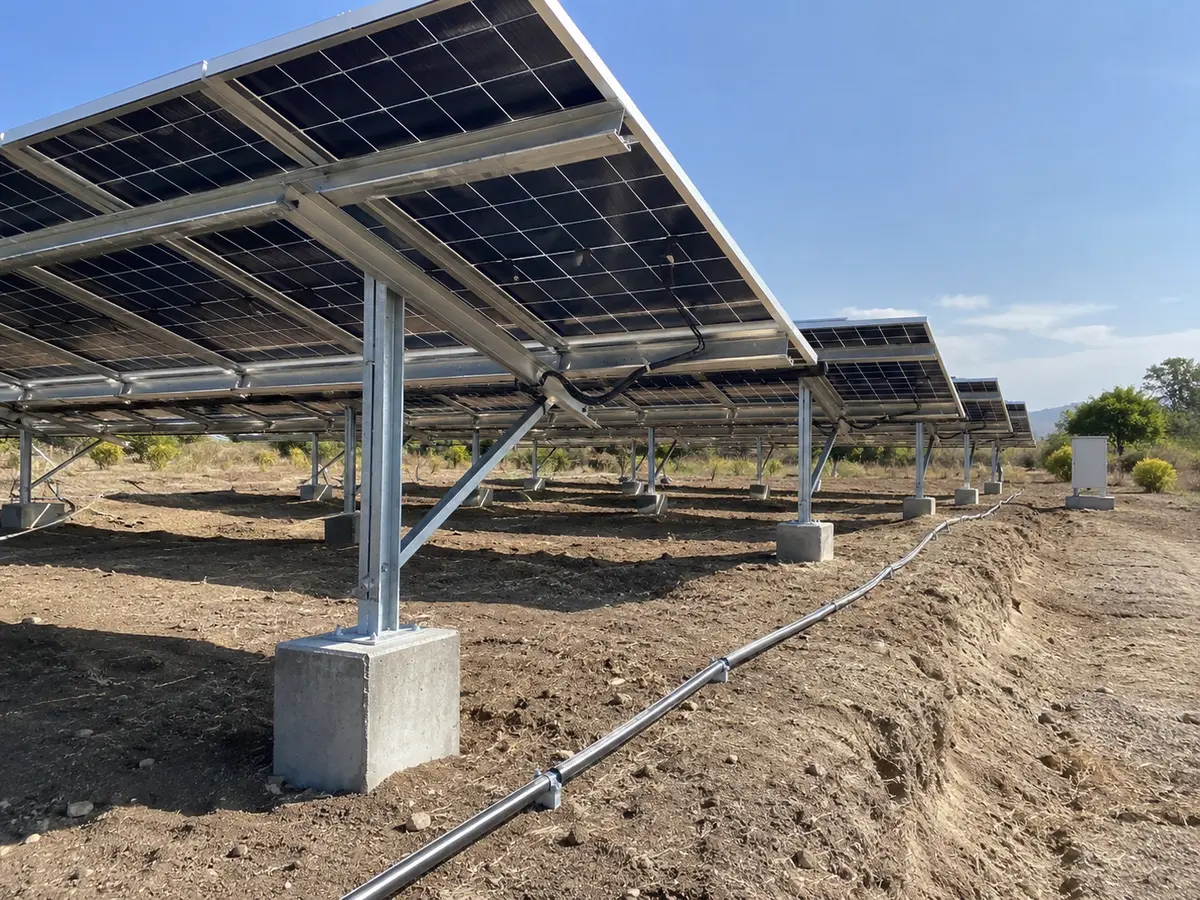
The support frame rarely receives as much attention as the modules, yet it is the part left outside to face every windy day and wet season. Its foundation, metal grade, coating and fasteners need a clear specification. Tilt and row spacing affect energy yield, but the practical details matter just as much: can someone reach the glass for cleaning, will grass or a fence cast shade, and can animals rub against the cables? In a flood-prone or insecure location, mounting height may protect far more than the appearance of the array.
Grundfos explains the effect of series and parallel wiring in its solar module guide. For the detailed voltage and current checks used during product selection, see our solar pump inverter sizing guide.
2. Solar pump inverter or pump controller
The inverter sits between the DC array and an AC pump motor. It converts DC into controlled three-phase AC and adjusts motor frequency as solar power changes. Depending on the model, it may include maximum power point tracking, soft starting, dry-run logic, level control inputs, fault records, sleep and wake functions, communication, and optional AC backup.
Start the output check with the motor voltage and rated current. The drive’s continuous output current must cover the motor after any temperature or altitude derating. On the input side, compare the array’s temperature-adjusted Vmp and Voc with the exact inverter limits. Product family names are not enough; record the complete model code and revision.
“Outdoor use” is one of those short notes that creates more questions than it answers. Is the drive under a roof, or inside a steel cabinet facing the afternoon sun? An IP20 unit needs both protection and somewhere for its heat to go. Rain matters, of course, but so do fine dust, insects, damp mornings, poor cable glands, and hands reaching into the wrong place. The survey sheet may show a comfortable air temperature while the closed cabinet is already becoming an oven. We take that seriously. The person recording the temperature can walk away after five minutes; the inverter cannot.
When comparing solar pump inverter models, read beyond the power number. The voltage class, rated output current, enclosure, I/O, and permitted backup arrangement may change between versions. Use the manual for the complete order code before signing off the motor or string calculation.
3. Water pump and electric motor
The water source usually narrows the pump choice quickly, but it does not make the decision automatic. A narrow borehole often needs a submersible set. A shallow, accessible source may suit a surface centrifugal pump. Higher pressure can lead to a multistage design. Irrigation is less forgiving than it first appears because sprinkler pressure and the number of open zones can keep changing. The pump curve has to cope with the real operating pattern, not just one attractive point in a catalogue.
Place the required flow and total dynamic head on the pump curve and look closely at where the model will run. A curve that only just touches the duty point leaves little comfort when the water level or pipe loss changes. Efficiency, speed range, suction conditions, impeller material, solids tolerance, and permitted starts all deserve a second look. For a submersible set, include the borehole diameter and setting depth. Cable support, cooling flow past the motor, and the presence of a non-return valve are small details until one of them is missing.
A clear motor-plate photograph is far more useful than a message that says only “5.5 kW pump.” The plate lets us check phase, voltage, rated current, frequency, speed, connection, insulation class, and protection marking without relying on a retyped value. Rated current deserves particular attention. Two motors can carry the same kW label and still ask very different things from the inverter.
| Interface | Information to compare | Typical problem |
|---|---|---|
| PV array to inverter | Hot Vmp, cold Voc, input current, and array power | String voltage falls outside the usable window |
| Inverter to motor | Output voltage, continuous current, frequency, and cable length | Selection made from kW without checking current |
| Motor to pump | Speed, shaft or integrated construction, load, and cooling | Motor cannot carry the pump duty reliably |
| Pump to pipe system | Flow, total dynamic head, suction, outlet size, and water quality | Pump curve misses the real duty point |
| Tank to controls | Level range, sensor type, cable distance, and control state | Float logic is reversed or unsuitable for the input |
4. Pipes, valves, intake parts, and water storage
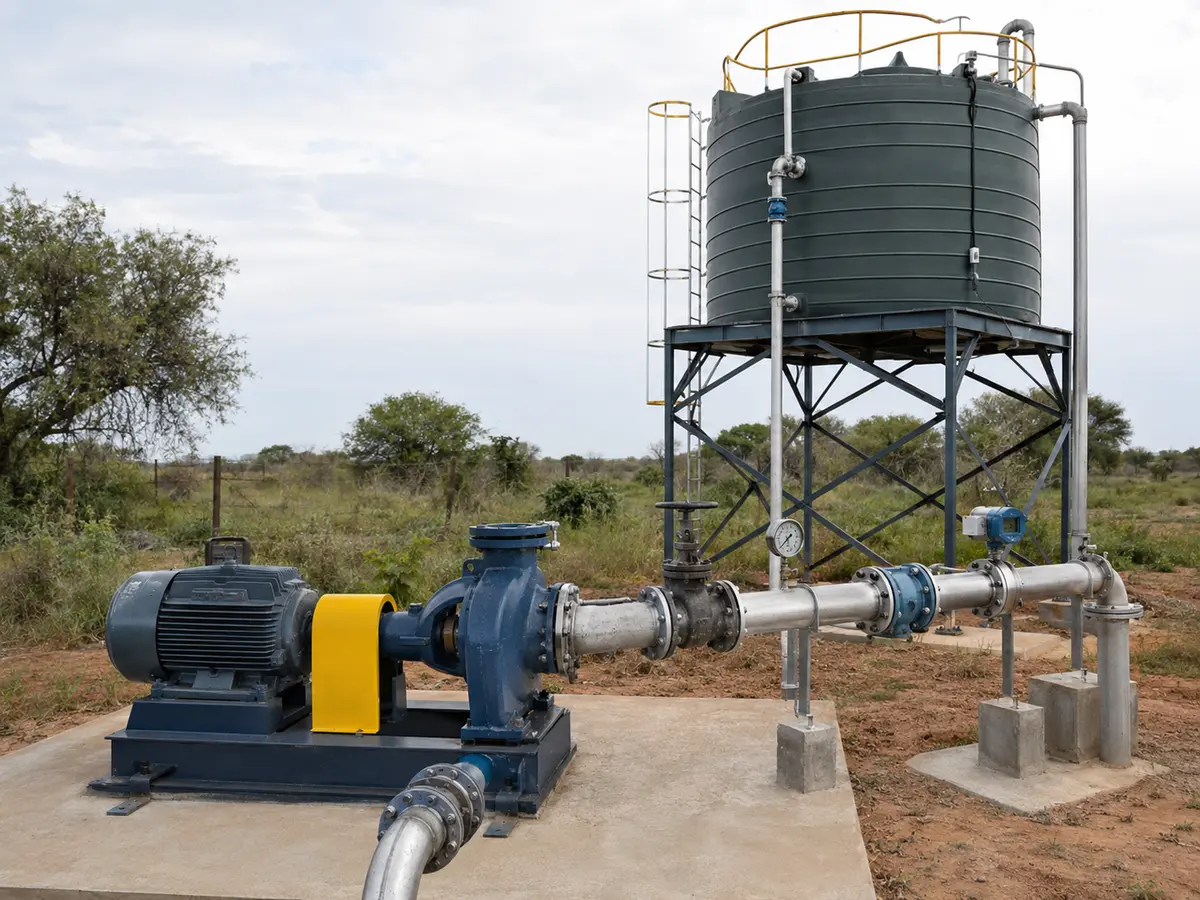
The hydraulic package often receives less attention than the electronics, yet it directly affects head loss and maintenance. It can include suction pipe, rising main, delivery pipe, foot valve, strainer, non-return valve, gate or isolation valves, pressure relief, flow meter, pressure gauge, fittings, supports, and a tank connection.
A smaller pipe can make the quotation look better for a moment. In service, the extra friction may demand more head and leave the customer with less water each day. That is a poor place to save money. Pipe material and pressure class must fit the whole route, including exposed sections, buried runs, water chemistry, and temperature. The drawing should also show exactly where the supplied package ends. Few things create more irritation at site than two parties each believing the other one included the same fitting.
A tank separates the hours of pumping from the hours of water use. During good sunlight, the pump fills storage; users can draw water later without a battery. Specify usable capacity, elevation, inlet and outlet levels, overflow, drain, cover, and level control positions. Irrigation systems may instead pump directly into a distribution network, but pressure and flow control then become more important.
5. Level controls, pressure sensors, and monitoring
A simple borehole-to-tank system may need only two dependable signals: protect the well when the water falls too low, and stop when the tank is full. That sounds modest, yet these two signals decide whether the pump runs safely without someone watching it. A pressure system asks for a different conversation. It may need a transducer or flow switch, and a larger project may also bring in irrigation commands, remote start, fault feedback, continuous well-level measurement, or RS485 communication.
Write the operating sequence as if you were explaining it to the person who will commission the panel. “Start at the lower tank level. Stop at the upper level. If the well runs low, wait 30 minutes before trying again” is much safer than a vague request for automatic control. Plain language prevents the panel builder, inverter supplier, and installer from each imagining a different sequence.
Sensor names alone do not help the electrician very much. The enquiry should say whether the output is a dry contact, 4–20 mA, 0–10 V, or something else, and include the supply, normal contact state, cable distance, wetted material, enclosure, and mounting method. Long outdoor signal cables deserve care. Without the right cable and surge plan, a control wire can become an unwanted path for noise or induced surge energy back into the panel.
6. DC and AC isolation, surge protection, and cabling
Protection cannot be chosen honestly while the string design is still moving. String count, voltage, current, cable route, and local rules decide whether the DC side needs fuses, an isolator or breaker, surge protection, a combiner box, and particular connector or cable ratings. Parallel strings are especially important because they can change the possible reverse current. A generic “solar protection box” may be easy to quote, but it gives the engineer very little to approve.
A PV combiner box can collect strings and house selected DC protection before the inverter. The quotation should state string count, system voltage, string current, outgoing current, fuse and breaker ratings, SPD configuration, monitoring, enclosure rating, gland sizes, and cable entry direction. Do not approve a box only from labels such as “four-string” or “1000 V.”
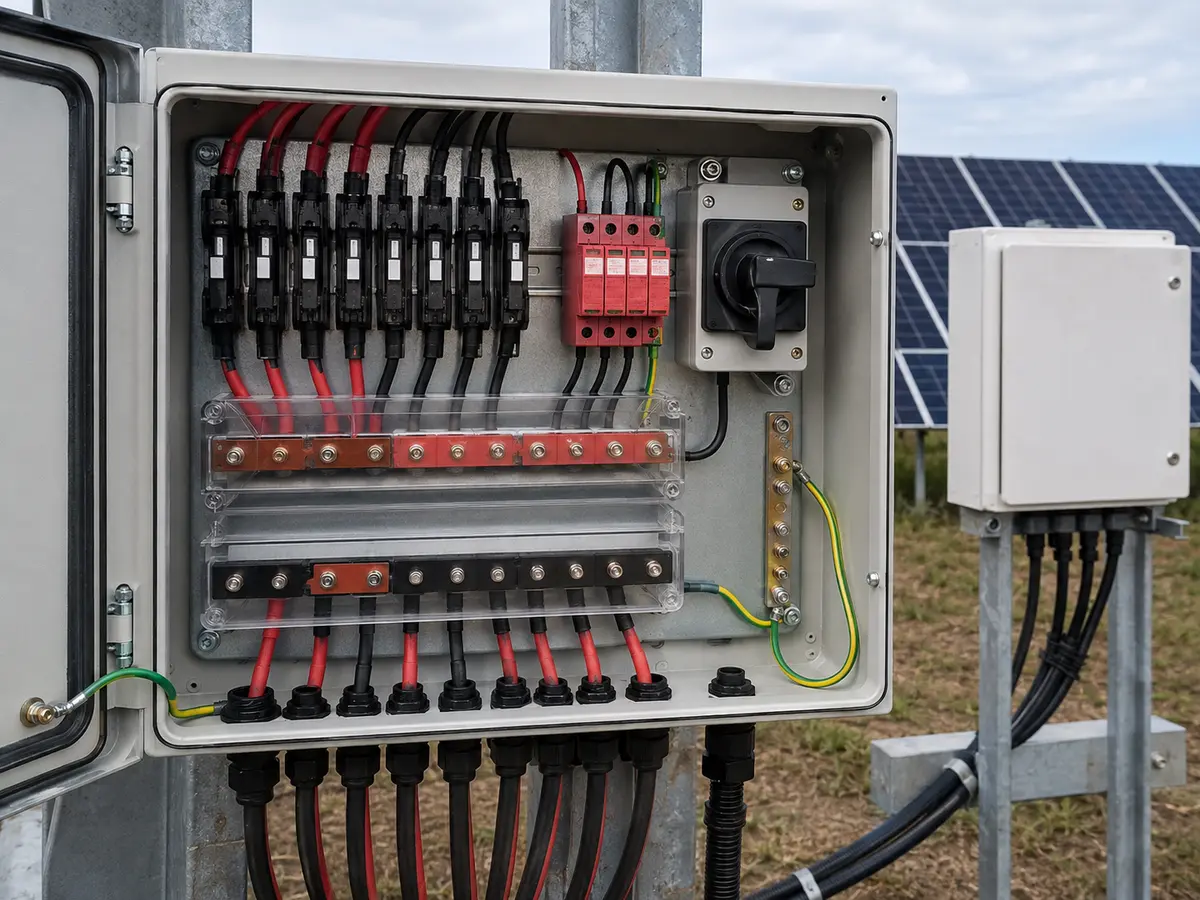
Earthing and bonding cover the module frames, mounting structure, enclosures, equipment protective conductors, and the site’s grounding arrangement. Lightning exposure, cable routing, and local requirements affect surge protection. On the motor side, verify output cable type, conductor size, voltage drop, length, jointing method, and any drive output filter recommended by the manufacturer.
UFELE groups combiner boxes, DC breakers, fuses, isolators, SPDs, and PV connectors under its solar energy equipment range. Each device still needs a voltage, current, pole, utilization, and enclosure check for the particular project.
7. Water storage, batteries, and backup power
Water itself is often the most sensible form of storage in this application. When daytime pumping is acceptable, a tank lets the system make use of good sunlight and keeps water available after the sun has gone. It is easy to understand, easy to inspect, and does not ask the operator to manage battery ageing or charge settings. The important question becomes practical: how much usable water must remain through the longest period when the pump cannot refill the tank?
Batteries are not a standard requirement for every solar pump. They add a battery bank, charge-control strategy, DC protection, thermal considerations, maintenance, and replacement cost. Use them only where the operating case justifies electrical storage and the chosen system supports it.
Grid or generator backup may suit sites with critical demand or a weak solar season. The engineer must confirm voltage, phase, frequency, source capacity, earthing, transfer method, and whether the inverter accepts a backup input. Never connect an AC source to PV terminals unless the product manual specifically permits that arrangement.
Turn the components into a quotation-ready system schedule
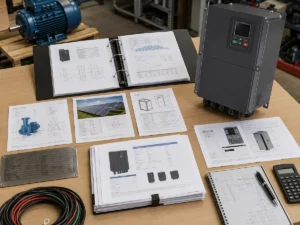
A useful request for quotation lets suppliers quote the same scope. Attach the pump curve, motor plate, PV module sheet, site sketch, pipe schedule, and control description. Use full model codes. Mark any item that will be purchased locally, and state who supplies installation materials, commissioning, spare parts, drawings, and manuals.
| Package | Data to include | Quotation output |
|---|---|---|
| Hydraulic duty | Daily volume, flow, head, pipe losses, and water source | Pump model and duty-point evidence |
| Pump and motor | Curve, voltage, current, phase, frequency, speed, and materials | Complete model, cable, and accessories |
| PV array | Module sheet, series count, parallel strings, climate, and mounting | Module quantity and string schedule |
| Inverter | Motor load, hot Vmp, cold Voc, controls, enclosure, and backup | Full order code and settings basis |
| Protection | String current, system voltage, earthing, cable route, and SPD need | Ratings and internal component list |
| Controls | Tank levels, dry-run method, sensors, signals, and sequence | I/O schedule and operating description |
Keep the approved schedule with the order. If the module, motor, pump, or inverter changes, repeat the checks affected by that change. A “similar” module may have a different Voc. A replacement motor may have a higher rated current. A revised pipe route can move the pump duty point.
Final review before order approval
- Pump curve reaches the required flow at total dynamic head
- Inverter output voltage and current match the motor
- Hot string Vmp and cold string Voc fit the inverter limits
- PV input current and permitted array power are confirmed
- Pipe, valve, cable, and enclosure scope is unambiguous
- Control logic, protection ratings, and backup source are documented
- Drawings, manuals, commissioning, and spare parts responsibilities are assigned
The system view also makes supplier discussions more efficient. UFELE can review the electrical portion through its electrical solutions range, including solar pump inverters, PV combiner boxes, and DC protection products. Send the available pump, motor, panel, and site information through the contact page; missing items can then be identified before the quotation is finalized.
Frequently asked questions
What are the essential solar pumping system components?
The essential parts are the PV array, mounting structure, pump controller or inverter, motor, pump, cables, pipes, valves, isolation, and electrical protection. Most installations also need water storage, level controls, dry-run protection, or pressure control.
Does every solar water pump need a battery?
No. Many systems pump during daylight and store water in a tank for later use. Batteries are added only when the operating requirement justifies electrical storage and the selected equipment supports it.
Why is a solar pump inverter needed?
For an AC motor system, the inverter converts PV DC into controlled three-phase AC. It can also track available solar power, vary motor speed, soften starting, process sensor inputs, and protect the pump under selected fault conditions.
Is a PV combiner box required for every solar pump?
Not always. The need depends on string count, current, system voltage, isolation, overcurrent rules, surge protection, monitoring, and local requirements. A small single-string system may use a different arrangement from a multi-string project.
Can the pump be selected from daily water volume alone?
No. Daily volume must be considered together with required flow, total dynamic head, pumping hours, the pump curve, water level, pipe losses, and seasonal solar conditions.
What information should a buyer send for a complete quotation?
Send the project location, water duty, source and level data, pump curve, motor nameplate, PV module sheet, proposed string arrangement, cable and pipe lengths, climate, control logic, enclosure needs, and any grid or generator backup requirement.