A field rarely gives us tidy catalogue inputs. It gives us a crop that cannot wait, a water level that moves, and a pipe route that is often longer than expected. We start there. The aim is to turn those awkward site facts into a solar water pump specification that a supplier can price without quietly guessing at the missing parts.
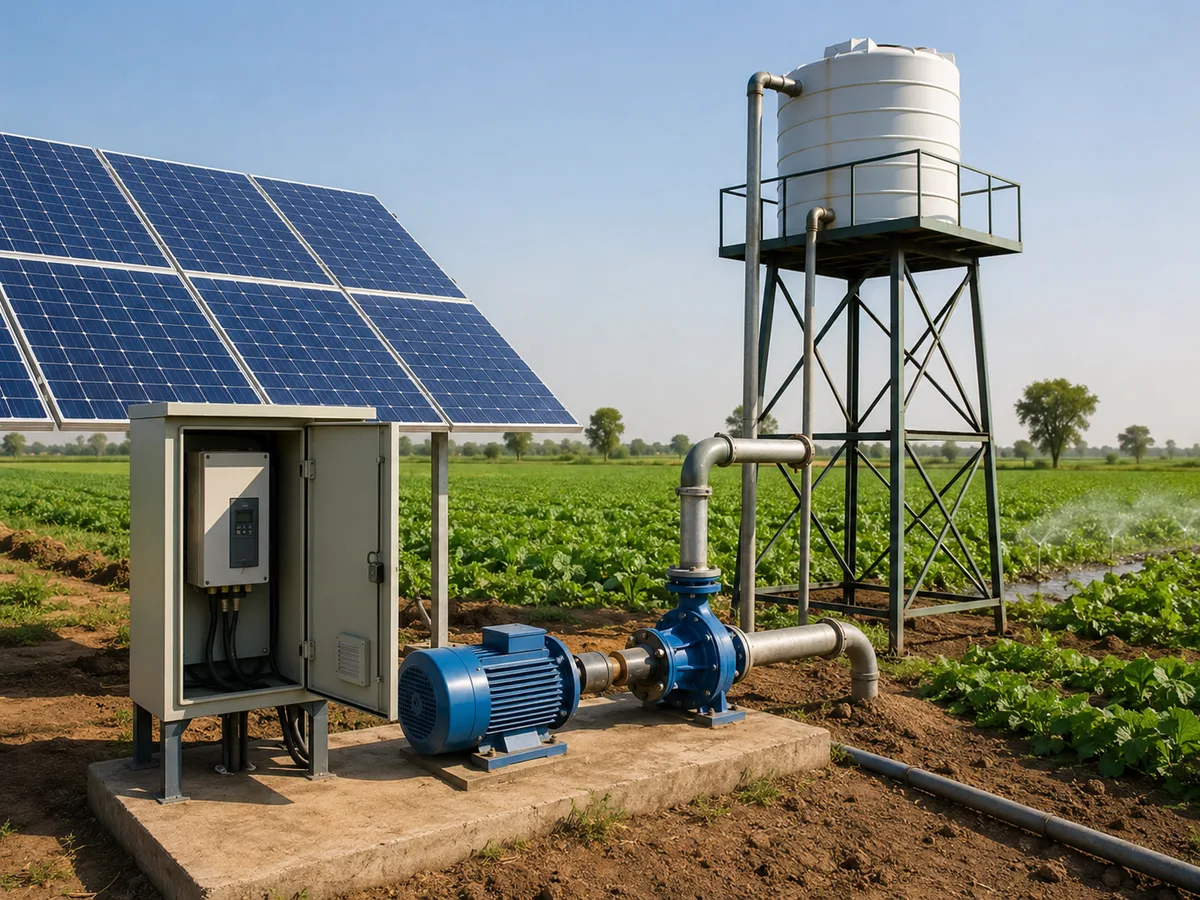
How do you choose a solar water pump for irrigation?
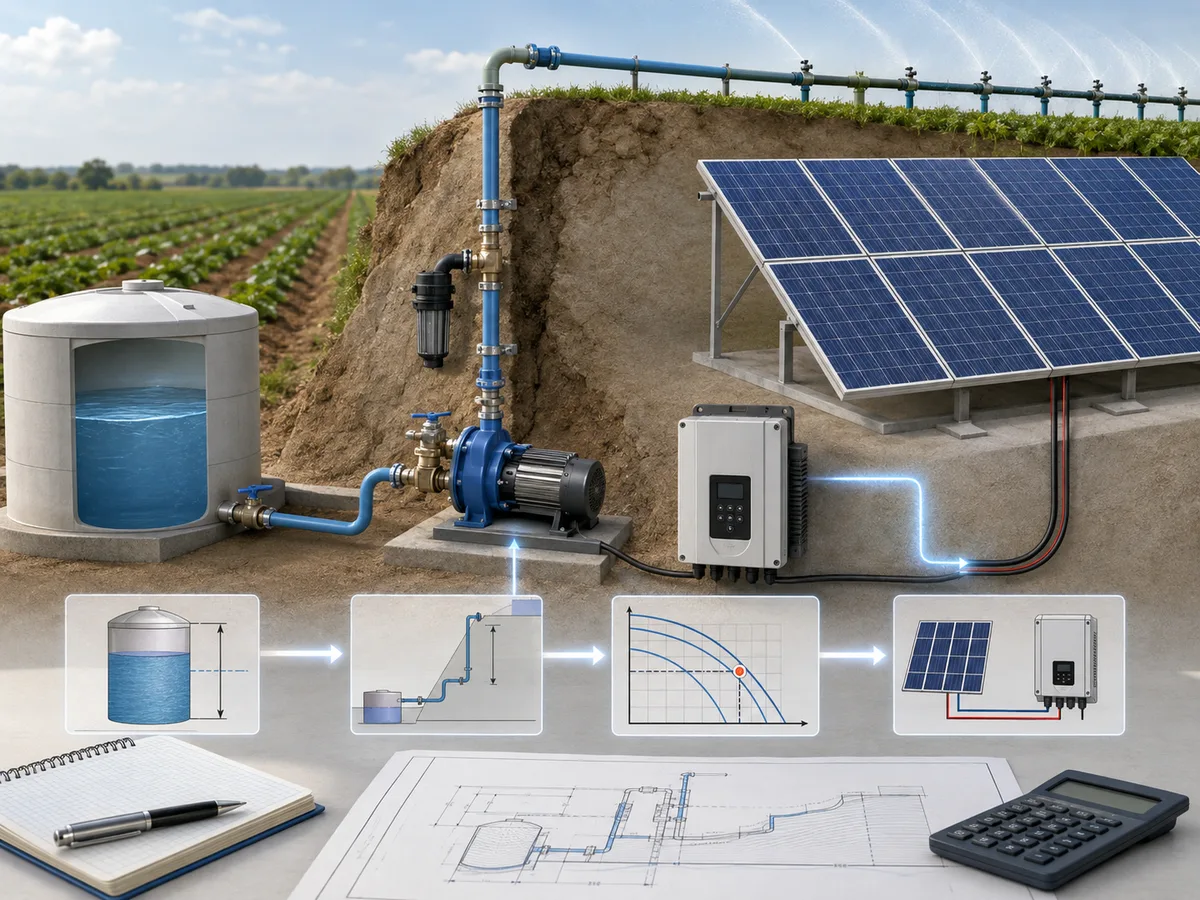
Do not choose it from acreage or motor kW alone. First find out how much water the crop needs on a hard day and how many hours of useful sunlight can honestly be counted on. That gives us a flow target. Next, follow the lift, pipe, filters, fittings, and outlet pressure to find the real head. Only then do we open the pump curve. Once the pump is settled, its motor plate leads us to the inverter. The PV string comes last: it must work comfortably inside the MPPT window and remain below the DC limit on the coldest likely morning.
“I have ten hectares. Which horsepower should I buy?” is the kind of message that makes me pause. I understand the wish for a quick number; the buyer may only be trying to see whether the project fits this year’s budget. But ten hectares tells us painfully little. Drip lines beside a shallow reservoir and sprinklers above a deep borehole may cover the same area while asking the pump to do completely different work.
When those two farms receive the same pump recommendation, somebody is guessing. The guess may survive on a mild day. It usually becomes uncomfortable when the crop needs more water, the well level falls, or a long pipe steals pressure. We would rather slow down at the beginning than watch an installer fight a system that never had a fair chance.
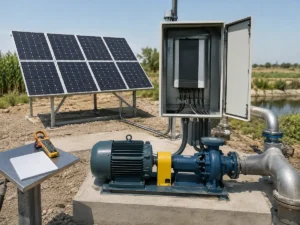
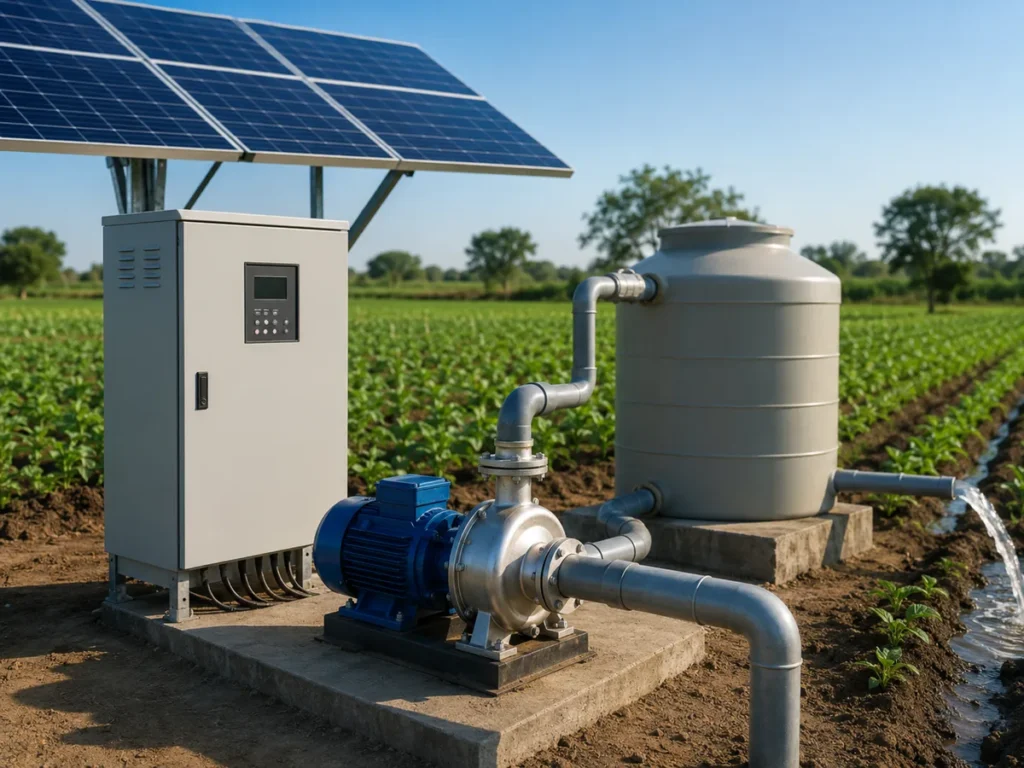
A solar powered water pump for irrigation is not one product working alone. The complete route includes the water source, pump, motor, pipe, valves, filters, irrigation network, solar modules, mounting structure, solar pump inverter, sensors, protection, and often a storage tank. Our solar pumping system components guide explains those parts. Here, we keep the focus on how they serve an irrigation schedule.
1. Begin with daily water demand, not pump power
The number I want first is not kW. It is cubic metres on the day when the crop is least forgiving. That value changes with the crop and its growth stage, but also with soil, weather, rainfall, planted area, and losses in the irrigation method. This is where we know our boundary as an electrical manufacturer. A local agronomist or irrigation designer should establish the crop-water requirement; a pump supplier should not make one up after looking at a green field in a photograph.
Once the daily volume is known, ask how much of the day is genuinely useful for pumping. The division is easy: 70 m³ over seven productive hours starts at 10 m³/h. The uncomfortable part is deciding whether seven hours is honest. A sales calculation may count every bright hour between sunrise and sunset. The farm will feel the difference when haze, cloud, hot modules, pipe loss, and the real pump curve take their share. So I write 10 m³/h as a starting point, not as a promise.
The first calculation—and the first reality check
Required average pumping flow = peak daily water volume ÷ realistic pumping hours.
The word “realistic” does most of the work here. We check local solar data and leave room for mornings, afternoons, heat, and imperfect weather. A tank gives the pump freedom to follow the sun. Direct-pressure irrigation is less patient; when the sunlight softens, the farmer may see the pressure change at the emitters or sprinklers.
This is also why I value the FAO guidance on solar-powered irrigation. It does not treat the panels and pump as an isolated shopping list. It brings the crop, location, water source, and weather back into the decision. The warning on water management matters just as much. Free sunshine can make pumping feel free, but the well still has a limit.
2. Drip, sprinkler, and tank-fed irrigation ask different things from the pump
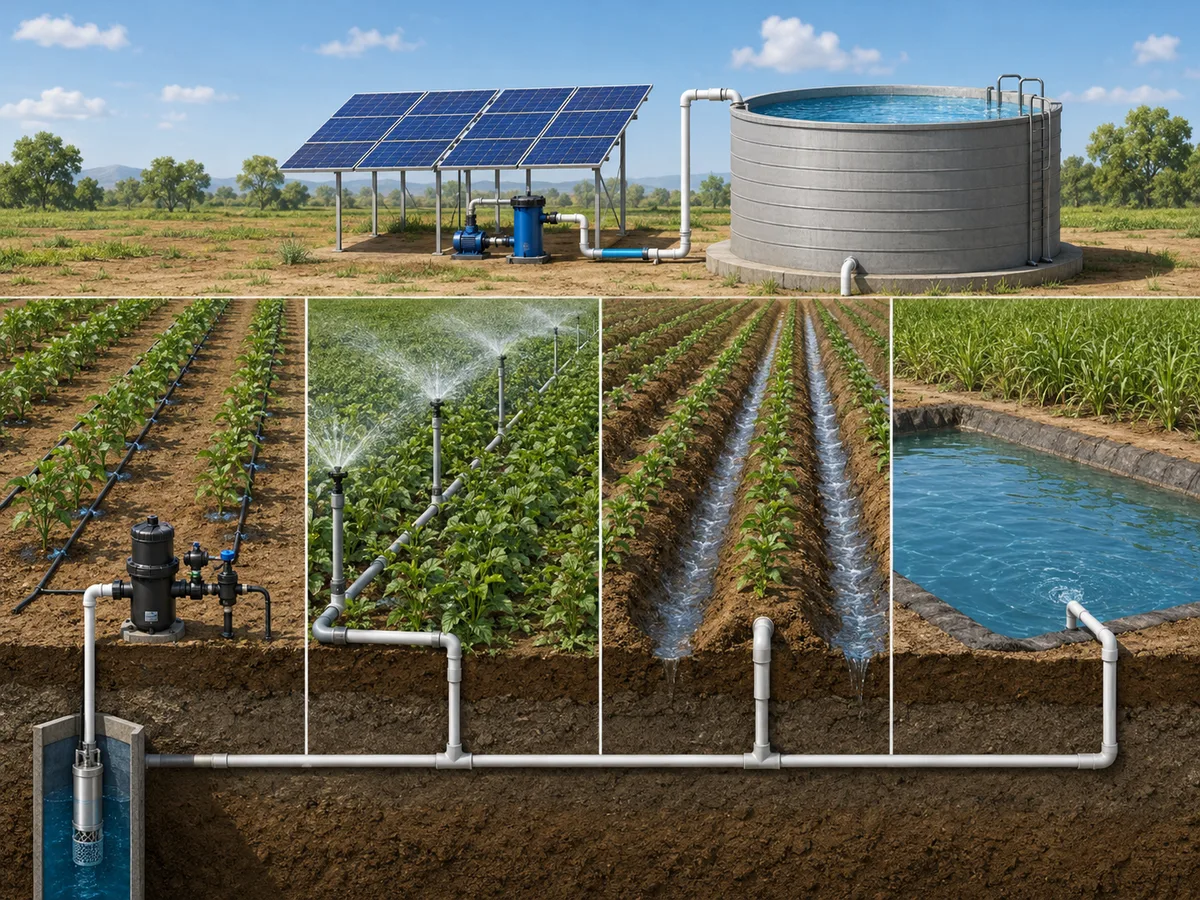
“Irrigation” is too broad for final selection. Drip lines usually work with lower flow per outlet, but emitters still need a controlled pressure range and clean water. Filters can add head, and a clogged filter can change performance sharply. A solar powered irrigation pump feeding drip zones may run one section at a time so the pump stays near a useful operating point.
Sprinklers often require more pressure at the nozzle. Large elevation changes or several active sprinkler lines can raise both flow and head. If the system pressure falls whenever sunlight softens, distribution becomes uneven. A storage tank, pressure-control strategy, smaller zones, or a different operating schedule may give a better result than simply choosing a larger motor.
Flood or furrow irrigation may need less pressure, which looks reassuring at first. Then the daily volume appears, and the pump and array are no longer small. Surface water adds its own untidy reality: weed around the intake, sand after rain, silt, floating debris, or a waterline that retreats through the season. I would rather discuss the intake now than hear later that a perfectly good inverter is controlling a pump that can barely breathe.
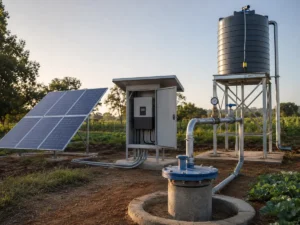
A tank-fed layout separates water collection from field delivery. The solar irrigation pump fills an elevated or ground-level tank during the day. Gravity or a second pressure pump then feeds the network. This arrangement adds civil work and storage cost, but it can turn variable solar input into a more predictable irrigation supply. On many farms, water storage is easier to maintain than a large battery bank.
| Irrigation arrangement | Main hydraulic concern | Useful design response |
|---|---|---|
| Drip irrigation | Emitter pressure, filtration, zoning, and clogging | Confirm minimum pressure at the farthest line and include filter loss |
| Sprinkler irrigation | Nozzle pressure and simultaneous flow | Define active zones and pressure at the most difficult sprinkler |
| Flood or furrow | Large water volume and source condition | Check intake, debris, pump curve, channel loss, and daily operating time |
| Tank filling | Daily volume and delivery elevation | Pump with available sun, use level controls, and size useful storage |
| Direct pressure system | Variable sunlight changing pressure and flow | Review pressure control, minimum speed, zoning, and backup plan |
3. Calculate total dynamic head without confusing it with well depth
One of the most expensive shortcuts is writing “80 m well” in an RFQ and calling that the head. The pump does not lift water from the bottom of the drilled hole. It lifts from the pumping water level. That level may drop while the pump runs, especially in a dry season or when nearby wells are active.
Static water level is the level before pumping. Dynamic water level is the expected level while the required flow is being withdrawn. Vertical lift continues from that dynamic level to the discharge point or tank. The irrigation network may then require additional pressure. Pipe friction, valves, bends, filters, check valves, and other fittings add further loss.
Total dynamic head framework
TDH = vertical lift from pumping water level + required outlet pressure head + pipe and fitting losses.
Add a justified margin for uncertainty and ageing, but do not hide poor data behind a huge safety factor. Oversizing can move the pump away from an efficient operating point and increase the motor, inverter, array, pipe, and protection cost.
For surface water, record the lowest expected source level rather than the waterline seen during a wet visit. For a well, ask for the bore diameter, pump setting depth, static level, dynamic level at the target flow, recovery information, and water quality. If the dynamic level is unknown, a pumping test can be far more valuable than another round of catalogue comparisons.
Pipe diameter matters. A small pipe may cost less at purchase and lose far more head along a long run. That extra head becomes electricity and PV capacity for the life of the system. Before approving a pump, let the hydraulic designer compare pipe cost with long-term pumping demand.
4. Select the pump where flow and head meet on the curve
A pump is not simply “10 m³/h” or “100 m head.” Its available flow changes with head. Find the duty point where the required flow and total dynamic head meet on the manufacturer’s pump curve. Then check efficiency, allowable operating range, motor rating, and the way performance changes as the solar pump inverter varies speed.
Submersible borehole pumps fit many deep-well projects. Surface centrifugal pumps suit other sources, but suction conditions require care. Long suction lifts, air leaks, poor priming, warm water, and restricted inlet pipes can create trouble that no inverter parameter will fix. Choose the pump type around the source, not around what happens to be in stock.
Send the pump curve with the motor nameplate whenever possible. Head, flow, voltage, phase, rated current, power, frequency, speed, insulation, duty, cable length, and pump model help the inverter supplier check the application. If the pump already exists, photographs of both plates are useful. If it is new, keep the selected pump curve in the approved order file.
5. Match the solar pump inverter to the motor—not only to kW
The motor’s rated voltage, phase, current, and power define the starting point. Output current often settles the model. A pump motor with an unusually high current for its kW may need the next inverter size. High ambient temperature, altitude, enclosure temperature, long motor cables, or other application conditions can also require derating or additional measures.
Do not mix up input and output phases. Some small systems can accept single-phase AC backup while driving a three-phase pump motor, but this depends on the exact product. The model’s input voltage, PV input, AC-backup arrangement, and motor output must all be stated. Never assume the word “hybrid” defines the switching and protection architecture.
Pump functions also need evidence. Dry-run protection may rely on power estimation, current behaviour, a probe, or another sensor. Tank-full control usually needs a float or level signal. Sleep, wake, automatic restart, minimum frequency, pressure control, and fault recovery should match the irrigation method. Ask for the relevant manual pages instead of accepting a list of icons.
The UFELE solar pump inverter range covers different power and enclosure requirements. Use our solar pump inverter sizing guide to prepare the motor and site data. If supplier evaluation is still open, the manufacturer guide explains what evidence to request.
6. Size the PV array for voltage first, then useful pumping energy
PV string design has two different jobs. First, the operating voltage must sit inside the inverter’s MPPT range under real module temperatures. Second, the cold-weather string open-circuit voltage must remain below the inverter’s absolute maximum DC input voltage. A string can fail one condition even when its total wattage looks generous.
Use the module datasheet values for Voc, Vmp, Isc, Imp, Pmax, and temperature coefficients. Hot modules produce lower operating voltage. Cold modules produce higher Voc. The project designer should calculate both ends with site temperatures, not room-temperature labels alone. Our solar panel sizing guide for water pumps walks through these checks.
After the voltage window is safe, review array power and daily energy. PV oversizing can help the pump start earlier, continue later, and cope better with weaker irradiance, but the permitted array size and input current still follow the inverter manual. More modules cannot correct the wrong pump duty point or an unrealistic daily-water target.
Shade deserves a physical site review. A small shadow from a tree, pole, wire, or nearby structure can affect a string. Soiling also matters on farms. Leave access for module cleaning, cable inspection, vegetation control, and safe isolation. A theoretical yield means little if the array becomes difficult to maintain after one growing season.
7. Use water storage and controls to make solar variability manageable
A cloud passing over the array does not change the crop’s water requirement, but it can change pump speed. Storage gives the system room to breathe. The pump can collect water when sunlight is available, while the irrigation network draws from the tank according to its own schedule.
Size storage around the operating plan and acceptable interruption, not a fashionable number of hours. Check usable volume, inlet and outlet positions, overflow, sediment, water quality, structural support, and access for cleaning. A level switch should stop the pump before overflow. Low-source protection should stop withdrawal before the pump runs dry or the well is pulled down too far.
Direct irrigation may still be appropriate. If so, define how the system responds to changing irradiance. Pressure sensors, minimum-frequency settings, zone valves, a pressure vessel, or AC backup may help. Control should remain understandable to the people who operate the farm. A sophisticated panel that nobody can diagnose during irrigation season is a fragile solution.
8. Design for the difficult month, not the pleasant site visit
The hardest irrigation period can combine several unfriendly conditions. Crops need more water. The well’s dynamic level falls. Dust accumulates on the modules. Ambient temperature rises, while a sealed enclosure has less ability to reject heat. Those effects do not arrive one at a time.
Ask for monthly water demand, solar resource, source level, and temperature where reliable records exist. A design should explain which month controls the array, pump, storage, and operating schedule. If grid or generator backup is essential, define when it starts, how sources are isolated, and who approves the wiring.
I become cautious when a proposal promises the same daily output in every season without showing its assumptions. A useful forecast admits variability. It states the target conditions, expected water volume, margin, and what the farm should do during prolonged cloud or an unusually low water level.
9. Treat it like farm equipment—because that is where it must survive
A farm is hard on electrical equipment. Dust works into gaps. Insects find warm enclosures. Irrigation water travels farther than anyone expects, and fertilizer chemicals are not kind to metal or cable entries. An IP20 inverter therefore needs a real cabinet and a believable way to lose heat. IP65 gives more protection, but it is not permission to mount the drive in full sun, use the wrong glands, or leave it where runoff can rise around the enclosure. I feel much better seeing an installation sketch than another promise that the box is “waterproof.”
Provide DC isolation and overcurrent or surge protection where the design requires it. Coordinate earthing, lightning protection, AC backup protection, motor protection, and cable ratings with local rules and qualified electrical engineers. Our PV DC protection products can form part of that scope, but device ratings must follow the actual string voltage, current, fault level, and installation.
Long motor cables may require a larger conductor, output reactor, dv/dt filter, or other measures depending on the inverter and motor. Voltage drop also affects performance. Keep power cables separated from low-level sensor and communication wiring where the manual requires it.
Before approving the layout, picture the person who will return during the busiest irrigation week. Can that person isolate the system safely, reach the filter, read the fault history, and test the float switch without dismantling half the installation? Give that operator the correct manual, the final wiring drawing, and the parameter record actually used at commissioning. Add the spare-parts list and one named support route. A folder of unrelated manuals is not support; it is another problem left at the farm gate.
Let us slow down and check one tank-fed drip system
Suppose the agronomy work gives us 60 m³ for a demanding day. The plan allows six useful pumping hours and sends the water to a tank, not straight into the drip lines. On paper, that points to 10 m³/h. I would circle that number, then keep my calculator open. We still have water 22 m below ground while pumping, a tank inlet 6 m above ground, and another 7 m consumed by the pipe, filter, valves, and fittings at that flow.
Those figures give an initial TDH of 35 m. The arithmetic is neat; the site rarely is. Before adding a margin, I would ask whether 22 m is a tested pumping level, whether the filter loss is clean or dirty, and whether the pipe route on the drawing matches the trench. With those questions settled, the pump curve can be checked near 10 m³/h at the agreed head. Only the chosen pump’s real motor voltage, current, and power go forward to the inverter selection.
Now the PV modules finally enter the calculation. Their Voc and Vmp are checked with temperature, not simply copied from the front of the datasheet. Current, module power, the inverter’s MPPT window, and its maximum DC voltage all stay on the same worksheet. Then we ask the question the farm actually cares about: can this array deliver the day’s water within the six-hour plan? The tank-full signal and low-water protection get tested as working controls, not left as unticked items on a feature list.
This is a method example, not a reusable equipment schedule. Change the crop demand, useful solar hours, water level, pipe, tank elevation, or irrigation pressure, and the answer changes. That is precisely why a good RFQ carries the assumptions beside the result.
| Decision | Information needed | Evidence to retain |
|---|---|---|
| Daily water target | Crop, area, season, climate, soil, irrigation efficiency | Agronomy or irrigation calculation with peak-day volume |
| Required flow | Daily volume and realistic pumping window | Operating schedule and storage strategy |
| Total dynamic head | Dynamic water level, delivery height, pressure, pipe and fittings | Hydraulic calculation and pipe layout |
| Pump selection | Required flow and TDH, water source and quality | Pump curve with marked duty point and motor plate |
| Inverter selection | Motor voltage, phase, current, power, site and controls | Exact model rating, derating, functions, and manual pages |
| PV string | Module data, temperatures, solar resource and inverter limits | Hot Vmp, cold Voc, current, power, and energy check |
| Protection | Array, cables, backup source, environment and local rules | Single-line diagram, device ratings, enclosure and earthing plan |
What to send for an irrigation-system quotation
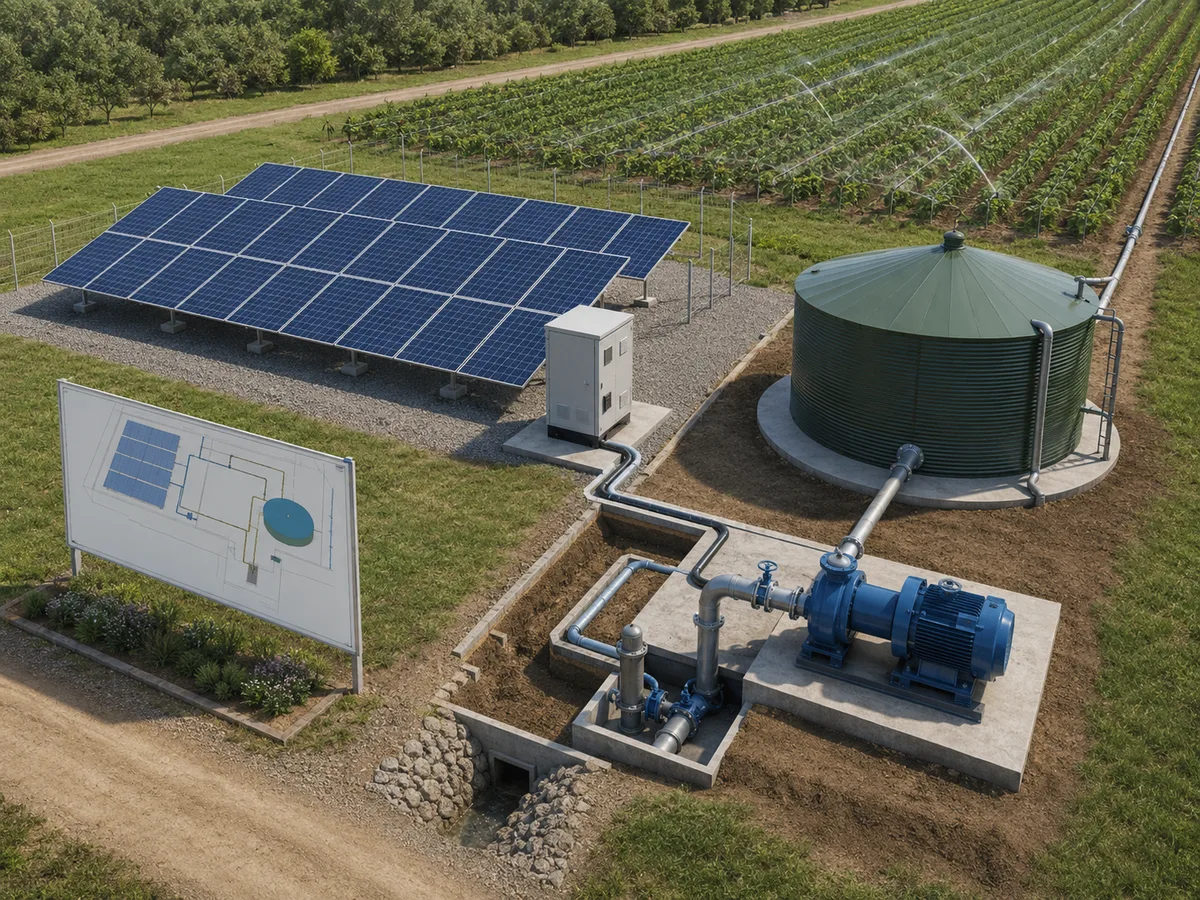
Start with the crop and water requirement. State the planted area, irrigation method, peak daily volume, irrigation schedule, active zones, required outlet pressure, and whether a tank will be used. If an irrigation designer prepared these values, attach the calculation.
Next, tell us what the water source is really like. A well record is useful when it shows bore diameter, pump setting depth, static level, and—most importantly—the dynamic level at the requested flow. Recovery data and water quality can change the decision too. For a reservoir, river, or canal, a rough sketch and a few honest photographs often say more than a polished sentence. Show the lowest seasonal waterline, where the pump will sit, how far it is away, and what debris or silt reaches the intake.
I also want to see where the water goes after it leaves the pump. Mark the rise in elevation and the tank height. Note the pipe’s actual internal diameter and material, not just the trade name printed on an invoice. Count the long runs, filters, valves, elbows, and other fittings. If a pump has already been chosen, send its curve and motor plate. If it has not, say so plainly; that tells the supplier that pump duty is still part of the work rather than a decision to assume.
For the electrical scope, include the PV module datasheet, minimum and maximum temperature, solar-resource basis, shading, mounting location, motor-cable length, enclosure, AC backup, sensors, remote monitoring, quantity, destination, documentation, OEM needs, and target date.
What I would put in the inquiry file
- State the crop, irrigated area, difficult-season daily water demand, and months of operation.
- Show whether the field uses drip lines, sprinklers, flood irrigation, direct pressure, or tank storage.
- Write down the flow, pressure, active zones, and the hours when water must reach the field.
- Describe the source honestly, including static and pumping levels, sustainable yield, and water quality.
- Sketch the delivery route and mark elevation, pipe length, internal diameter, material, filters, valves, and fittings.
- Attach the selected pump curve and a clear motor-nameplate photograph if they already exist.
- Attach the PV datasheet; we need Voc, Vmp, Isc, Imp, Pmax, temperature coefficients, and the proposed quantity.
- Tell us about the site: sun, temperature, altitude, dust, rain, shade, and the intended mounting position.
- Explain how the tank level, low-water condition, pressure signals, and remote monitoring should behave.
- Finish with AC backup, cable lengths, protection scope, quantity, destination, documents, and any OEM work.
UFELE Electric can review the pump-motor and PV-inverter match after the hydraulic duty is clear. Send the file through our contact page. If the water demand, pumping level, or pipe data are uncertain, we will mark the gap. An honest question during quotation is far less painful than a confident answer that fails in the field.
Questions buyers usually ask before they trust the selection
What size solar water pump do I need for irrigation?
I cannot answer that responsibly from the farm area alone. Give me the difficult-day water volume, honest pumping hours, and total dynamic head. Then we can mark the duty point on a pump curve and check the motor. That may take a little longer than naming a horsepower, but it produces a size we can defend.
Can a solar pump run drip irrigation directly?
Yes, but I would first look at the farthest emitters when sunlight drops. If their pressure falls outside the intended range, the field will not care that the pump is technically still running. Zoning, pressure control, or a tank often makes the result calmer and easier to manage.
Can a solar powered irrigation pump run on cloudy days?
Usually it will keep trying while enough solar power remains, though speed and water output can fall. The honest question is whether the reduced daily volume still protects the crop. A suitable PV allowance, stored water, a different schedule, or properly designed AC backup can provide breathing room.
How many solar panels are needed for an irrigation pump?
Please do not choose the quantity from motor kW alone. I need the module datasheet, temperature range, local sun, pump duty, and the inverter’s MPPT, current, power, and maximum-voltage limits. We check the string on a hot operating day and a cold morning before calling the quantity safe.
Is a water tank better than batteries for solar irrigation?
Often I would rather store water than store electricity. A tank is visible, familiar, and usually easier for a farm team to inspect. Still, it needs space, structure, cleaning, and enough elevation or a second pump. Direct pressure or batteries may suit another schedule, so the irrigation method gets the final say.
What protection does a solar irrigation system need?
There is no honest one-line shopping list. The PV string, cables, backup source, motor, lightning exposure, enclosure, and local rules decide the devices and ratings. At minimum, we review safe isolation, overcurrent and surge protection, earthing, dry-run and level control, cable size, and the place where the equipment will actually live.